
7 AI Code Conventions That Keep Models and Teams Aligned
Discover essential AI code conventions that ensure models and development teams stay aligned, improving efficiency and consistency across AI projects. Practical strategies for engineering leaders and teams adopting AI.
Free tool
Free AGENTS.md generator
Write your conventions down once as an AGENTS.md that Codex, Cursor, Copilot, and Claude Code can all read. No account.
Quick Summary: AI code conventions are essential for maintaining consistency between models and teams. Key practices include creating a single source of truth for rules, using repo instruction files, standardizing naming and formatting, defining explicit error and test patterns, and validating output with automated checks. These conventions help reduce drift, improve review speed, and ensure reliable, maintainable code, especially when supported by tools like Moxie Docs that keep documentation aligned with code changes.
One developer asks an AI agent for constructor injection. Another gets field injection for the same kind of class. The app still builds, but the team has already lost consistency.
AI coding assistants move fast. Without shared rules, they copy local habits, stale repo context, and whatever the last prompt happened to imply. That drift shows up in reviews, slows onboarding, and leaves the codebase split into competing styles.
The fix is not a bigger prompt. It is a small set of durable AI code conventions every agent can follow. That means one source of truth, clear repo instructions, standard patterns, validation rules, and a simple loop to keep those rules current as the codebase changes.
We picked the seven conventions in this guide because they work across languages and frameworks, help both humans and agents, and can be enforced through repo files, code review, and CI. The aim is simple: cut ambiguity and keep output aligned with real team standards.
Quick Comparison#
| Convention | Best for | How it helps | Maintenance effort |
|---|---|---|---|
| Create a single source of truth for coding rules | Teams that want one consistent standard for humans and AI agents | Reduces ambiguity and keeps code style and behavior aligned | Low to moderate |
| Use repo-level instruction files | Teams using coding agents repeatedly in the same repo | Makes conventions available without re-prompting | Moderate |
| Standardize naming, structure, and formatting | Reducing stylistic drift in generated code | Makes code easier to read, review, and maintain | Low |
| Define explicit patterns for errors, tests, and dependencies | Critical paths where bugs are expensive | Keeps AI-generated code aligned with production expectations | Moderate |
| Require small, reviewable changes | Teams that want safer AI-assisted changes | Makes output easier to review, test, and revert | Low |
| Validate AI output with tests and checks | Teams that want convention enforcement, not just convention docs | Catches mistakes before they reach production | Moderate to high |
What to know about AI code conventions#
AI code conventions are the rules that guide how coding agents work inside your repo. They cover naming, file structure, test habits, commit scope, and how to use project context. The goal is not just code that runs. The goal is code your team can read, review, and keep over time.
This matters now because AI agents follow the context you give them. Clear rules lead to cleaner output and fewer weird one-off choices. Weak or scattered rules create drift fast.
If humans and models do not share the same working rules, review speed drops and cleanup work grows.
1. Create a single source of truth for coding rules#
Put your non-negotiables in one repo document before you ask an AI to write code. Prompts should point to standards, not replace them. Teams like Google keep shared style guides because consistent code is easier to read and maintain, as shown in the Google style guide repo.
Highlights
- Define project-wide rules once
- Add clear do-not rules for risky shortcuts
- Keep it short enough to maintain
- Update it like a living standard, not a policy file
Specs
- Best for: Teams that want one standard for humans and AI agents
- How it helps: Cuts ambiguity and keeps style and behavior aligned
- How it works: Store conventions in a maintained repo doc
- Maintenance effort: Low to moderate
Pros
- Easy to reference in reviews and prompts
- Stops prompt-by-prompt rule drift
Cons
- Can drift without an owner
- Too much detail makes it hard to use
Moxie Docs fits well here because living repo docs reduce drift after each merge, which mirrors how SAP maintains continuously updated style guides.
This ranks first because every other AI code convention depends on shared rules.
Last updated: July 23, 2026
Also Read: AI Code Conventions in 2026: Emerging Trends and Industry Insights
2. Use repo-level instruction files#
Put the rules where agents already look. A repo file like AGENTS.md keeps your build steps, guardrails, and patterns close to the code, so agents do not need the same prompt every time. OpenAI says Codex reads AGENTS.md before work starts, and GitHub supports agent instruction files across Copilot surfaces in many environments (OpenAI Codex guide, GitHub docs).
 Highlights
- Capture build, test, and lint commands that actually work
- List architecture boundaries, folder rules, and preferred patterns
- Keep errors, logging, and dependency choices explicit
- Keep the file lean enough that agents will reread it
Specs
- Best for: Teams using coding agents repeatedly in the same repo
- How it helps: Makes conventions available without re-prompting
- How it works: Loads durable instructions from a repository file
- Maintenance effort: Moderate
Pros
- Reduces repeat prompt writing
- Gives new contributors and agents the same baseline
Cons
- Goes stale when commands change
- Gets ignored when it turns long or vague
This ranks here because it turns forgotten guidance into live repo context agents can actually use.
Last updated: July 23, 2026
Also Read: How To Sync Documentation With Github And Keep It Alive As Your Codebase Evolves
3. Standardize naming, structure, and formatting#
Make easy decisions automatic for the model. Clear naming patterns, folder layout, file suffixes, import order, and formatting rules help AI output blend into the repo instead of standing out in review.

Highlights
- Define one rule for package, module, class, and file names.
- Keep feature folders organized the same way every time.
- Let linters and formatters enforce style, not reviewers.
- Pick one clear pattern for imports, exports, and file placement.
Specs
- Best for: Reducing stylistic drift in generated code
- How it helps: Makes code easier to read, review, and maintain
- How it works: Codify naming, folder, and formatting patterns
- Maintenance effort: Low
Pros
- Quick wins with immediate visual consistency
- Easy to automate with PEP 8 naming and import rules and Django’s formatter and import checks
- Improves onboarding because patterns are easier to learn
Cons
- Doesn’t solve deeper architectural inconsistency by itself
- Can get brittle if rules are too strict
It ranks here because surface-level consistency cuts cognitive load fast for both the model and the team.
Last updated: July 23, 2026
4. Define explicit patterns for errors, tests, and dependencies#
Tell the model how critical code should behave. AI code conventions matter most where output fails quietly: errors, tests, validation, logging, and dependency setup. NIST’s SSDF and its developer verification guidance both stress clear, repeatable secure development and testing practices.
 Highlights
- Specify approved error types, message format, and retry or fail-fast paths.
- Set minimum testing standards for new logic, edge cases, and regressions.
- Define constructor and dependency injection patterns so AI does not wire services ad hoc.
- Document validation, logging, and observability rules.
Specs
- Best for: Critical paths where bugs are expensive
- How it helps: Keeps AI-generated code aligned with production expectations
- How it works: Document concrete patterns for errors, tests, and dependencies
- Maintenance effort: Moderate
Pros
- Improves correctness and maintainability
- Reduces repetitive review comments
Cons
- Needs updates as frameworks change
- Often needs examples to stay consistent
These conventions rank high because they protect reliability, not just style.
Last updated: July 23, 2026
Also Read: Ai Code Assistants And Living Documentation In 2026
5. Require small, reviewable changes#
AI writes fast. That helps until it dumps a huge diff no one can check with care. Keep AI work in small batch changes so humans can test, review, and roll back each step with less risk. DORA says working in small batches is a key safety net for AI-assisted delivery, and Google’s review guide explains why small CLs are reviewed more thoroughly.
Highlights
- Break work into one feature, one fix, or one refactor at a time
- Keep reviewable AI diffs narrow enough for real human inspection
- Prefer incremental development over big rewrites
Specs
- Best for: Teams that want safer AI-assisted changes
- How it helps: Makes output easier to review, test, and revert
- How it works: Limit each AI task to a narrow scope
- Maintenance effort: Low
Pros
- Improves review quality
- Reduces mistake blast radius
- Supports better team coordination
Cons
- Can feel slower at first
- Takes discipline to keep scope tight
Small batches rank here because they make AI code review trustworthy.
Last updated: July 23, 2026
Also Read: AI Code Conventions: How Moxie Docs Compares to DocuWriter.ai
6. Validate AI output with tests and checks#
Trust the model less; trust the verification more. A rule is not real until your repo can check it. NIST lists automated testing and static analysis as baseline software verification practices in its developer verification guidance, and its SSDF pushes teams to build repeatable secure checks into delivery.
Highlights
- Run tests, linting, type checks, schema checks, and security scans before merge.
- Use CI checks as quality gates, not optional advice.
- Treat failed checks as feedback on the code or the convention itself.
Specs
- Best for: Teams that want convention enforcement, not just convention docs
- How it helps: Catches mistakes before they reach production
- How it works: Pair coding conventions with automated tests and checks
- Maintenance effort: Moderate to high
Pros
- Creates objective quality gates
- Helps teams trust AI-assisted changes
- Surfaces broken assumptions early
Cons
- Needs strong test coverage
- Can slow merges if the pipeline is poorly tuned
Validation ranks here because it turns guidance into proof.
Last updated: July 23, 2026
More conventions to consider#
Teams with a solid AI workflow usually need one more habit: keep the rules current. Old guidance makes agents drift, even when the first setup looked good.
- 7. Refresh conventions as the codebase evolves - Review prompts, repo docs, and guardrails on a set cadence so agent behavior matches the code you ship now. Moxie Docs fits here because it helps teams spot doc drift and keep guidance aligned with each merge.
How to choose the right AI code conventions#
Pick conventions based on where your team already feels pain. Start with the rules behind the most review comments, rework, and production bugs. That gives you fast wins and makes adoption easier.
Use these criteria:
- Fix repeated failures first - choose conventions for naming, test coverage, error handling, and file structure if those keep breaking reviews.
- Keep guidance short - one shared file should be easy to scan in a minute or two. If it reads like policy, people and agents will skip it.
- Write rules an agent can follow - say “add tests for new business logic” instead of “write enough tests.” Clear beats broad.
- Store instructions in the repo - use repo-level files for repeat work. Do not rely on ad hoc prompt text that disappears after one session.
- Automate high-cost rules - add checks for formatting, linting, tests, and risky patterns. If missed enforcement can ship a bug, automate it.
- Plan for drift - revisit rules after big framework, architecture, or process changes.
If you want the safest pick for keeping conventions current, Moxie Docs stands out. It keeps repo documentation live as code changes, flags drift, and gives AI agents current codebase context instead of stale prompt scraps.
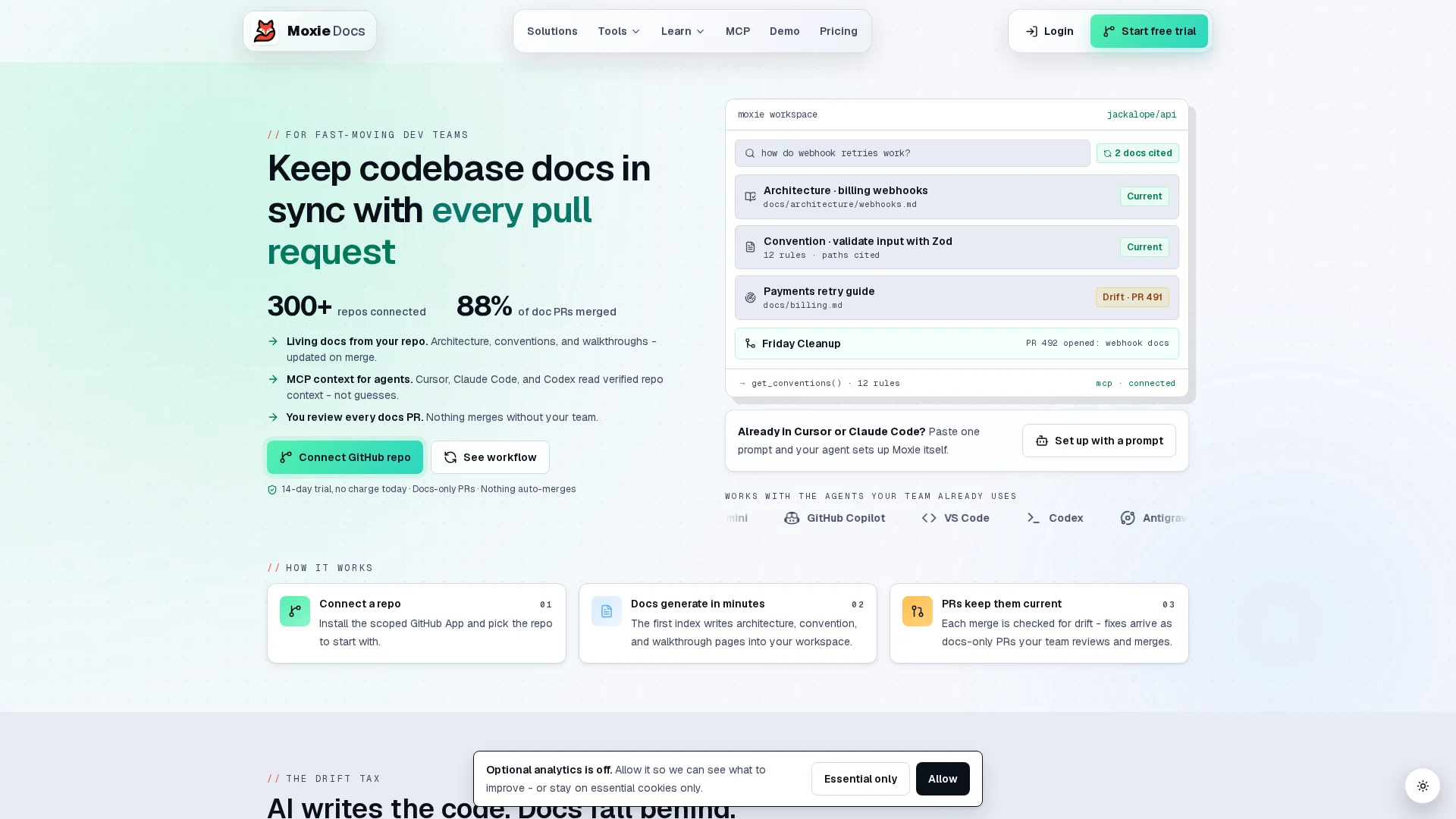
If you want these conventions to stick, give agents the same fresh repo context your team uses. Moxie Docs keeps docs in sync with every merge, flags drift, and feeds accurate context to AI coding agents so teams ship faster with less rework.
Frequently Asked Questions#
Q1: What are the top AI code conventions that ensure model and team alignment?#
Use shared repo rules, clear file ownership, small pull requests, strict naming, test-first checks, and documented decision records. Teams also need one source of truth for architecture and docs so AI agents stop guessing.
Q2: How do AI code conventions improve collaboration between human developers and AI models?#
They cut ambiguity. Humans review faster because outputs follow known patterns. AI agents make fewer off-path edits, ask better questions, and reuse existing design choices instead of creating random new ones.
Q3: How do AI code conventions improve collaboration between human developers and AI models?#
They make intent visible. Developers can trust AI changes more when structure, validation, and commit scope stay consistent. That lowers review fatigue and keeps handoffs smooth across shifts, squads, and mixed-skill teams.
Q4: What are best practices for implementing AI-friendly coding standards across teams?#
Start with a short ruleset, apply it in one repo, and enforce it in pull request templates and CI. Keep docs current. Tools like Moxie Docs help by giving agents live repo context and flagging drift.
Republish or cite this article
You're welcome to republish this piece in full or in part. We just ask that you credit the original with a link back. See our republishing guidelines.
Attribution snippet
<p>This article was originally published on <a href="https://moxiedocs.com/blog/7-ai-code-conventions-that-keep-models-and-teams-aligned">Moxie Docs</a>.</p>Cite this article
The Moxie Docs team. "7 AI Code Conventions That Keep Models and Teams Aligned." Moxie Docs, July 23, 2026, https://moxiedocs.com/blog/7-ai-code-conventions-that-keep-models-and-teams-aligned.
AGENTS.md vs CLAUDE.md vs llms.txt
Which instruction file each coding agent reads, where it lives, and how to keep one source of truth.
Read the reference guideRead next
Docs as Code on GitHub: A Workflow That Keeps Docs in the Pull Request
Docs as code means writing documentation with the same tools and review process as code. A practical GitHub workflow: repo layout, the CI checks worth running, a docs-required gate, and the gap none of them close — docs that are reviewed but no longer true.
Documenting APIs for AI Agents: OpenAPI, llms.txt, and MCP, and When Each One Matters
AI agents now read your API docs before developers do. What OpenAPI, llms.txt, Markdown pages, and an MCP server each give an agent, which one to build first, how to write descriptions an agent can act on, and how to keep all of them in sync with the code.