
AI Code Conventions: How Moxie Docs Compares to DocuWriter.ai
Compare Moxie Docs and DocuWriter.ai to evaluate AI code standards for documentation. Ideal for engineering leaders and developer-tool buyers seeking top AI documentation platforms.
- industry-trends
- documentation
Quick Summary: Moxie Docs is best if your team needs up-to-date, living documentation that syncs automatically with code changes and enforces conventions. DocuWriter.ai offers a broader range of outputs like API docs, UML diagrams, and tests, suitable for teams needing many artifact types. If keeping internal docs current and aligned with fast-moving code is your priority, go with Moxie Docs; for extensive documentation across multiple formats, choose DocuWriter.ai.
If your team needs AI Code Standards to stay in sync with a fast-moving GitHub repo, Moxie Docs is usually the sharper pick. If you need a wider set of outputs like API docs, UML, tests, and shared workspaces, DocuWriter.ai has the broader reach. That split matters because AI-assisted coding speeds up change, and docs often fall behind. Teams now need Living Documentation that updates with code, conventions, and architecture decisions. I evaluate Code Documentation Tools through the lens of repo sync, governance, and agent context, not just content generation. This comparison shows how both tools handle synchronization, collaboration, and AI Code Standards so you can choose the right fit and keep AI Code Standards current.
Moxie Docs vs DocuWriter.ai: At a Glance#
| Moxie Docs | DocuWriter.ai | |
|---|---|---|
| Primary focus | Living docs + AI agent context | Automated documentation generation |
| Real-time sync model | Indexes on merge; drift detection | Repository sync + Autopilot |
| AI code conventions support | Serves conventions over MCP | Custom AI preferences and templates |
| Documentation outputs | Source-cited docs, recaps, cleanup PRs | Code docs, API docs, UML, tests, release notes |
| Collaboration and governance | Repo-scoped, PR-based review | Spaces, teams, permissions, audit tools |
| Best for | Teams needing always-current conventions | Teams wanting a broad docs platform |
How Moxie Docs and DocuWriter.ai Compare#
Moxie Docs#
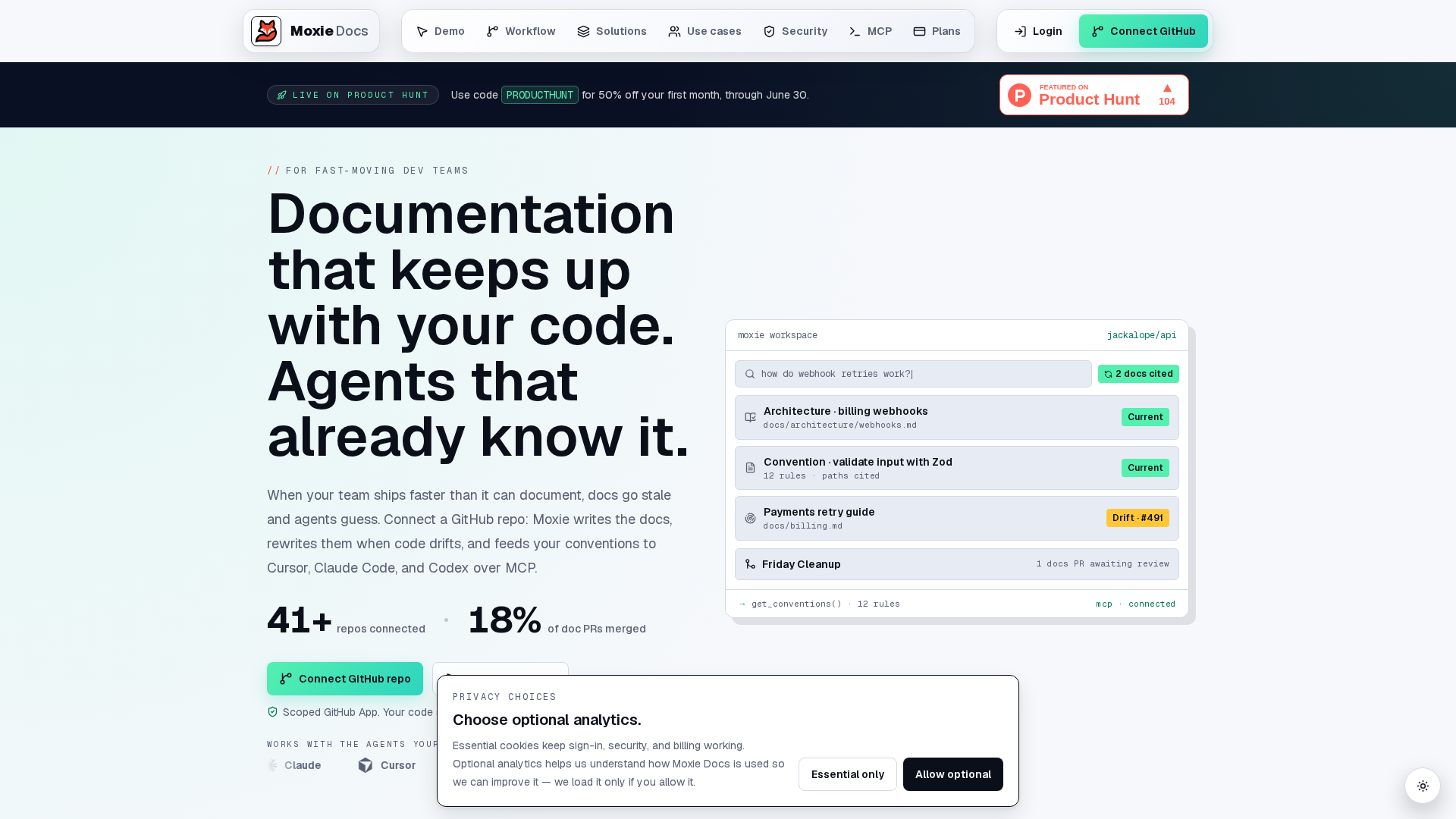
Moxie Docs is built for teams that want living repo docs, not one-off generated pages. Its angle here is keeping conventions current through merge-based sync, drift checks, and MCP context for agents, which fits platform teams that need docs to stay honest.
 Key strengths
- Living docs for GitHub repos
- Drift detection on merge
- MCP-served conventions and repo context
DocuWriter.ai#
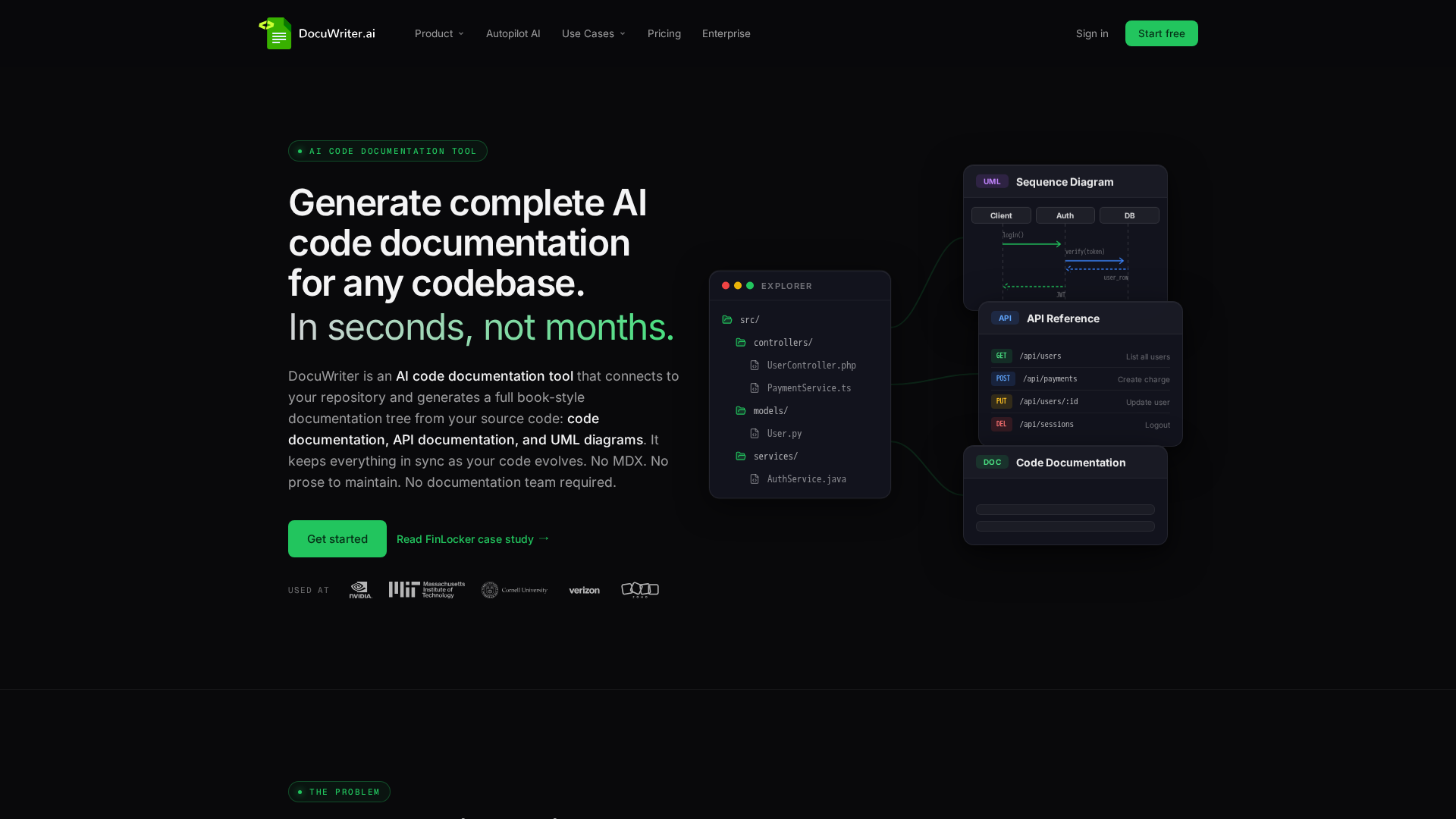
DocuWriter.ai is a broader AI documentation platform for teams that need many outputs from one workspace. Its angle in this comparison is breadth: repo sync, Autopilot, spaces, templates, and outputs like API docs, UML, tests, and release notes.
 Key strengths
- Broad documentation generation
- Multi-provider repo support
- Team spaces and audit tools
How They Handle Living Documentation#
“Living” documentation means the docs change when the code changes. If they lag, they stop being a source of truth. Research on more than 3,000 GitHub projects found that 28.9% of popular projects had at least one outdated code reference, and 82.3% became outdated at some point in their history, according to this Empirical Software Engineering study.
For buyers, that is the real test:
- Does the tool track drift after merges?
- Does it tie docs to real code objects?
- Does it update knowledge continuously, not just on request?
Moxie Docs fits the stronger “living” model because it is built around repo sync and drift control. DocuWriter.ai is better read as a broader documentation generator. It can help teams create docs fast, but “living” depends more on how often the team reruns and manages outputs.
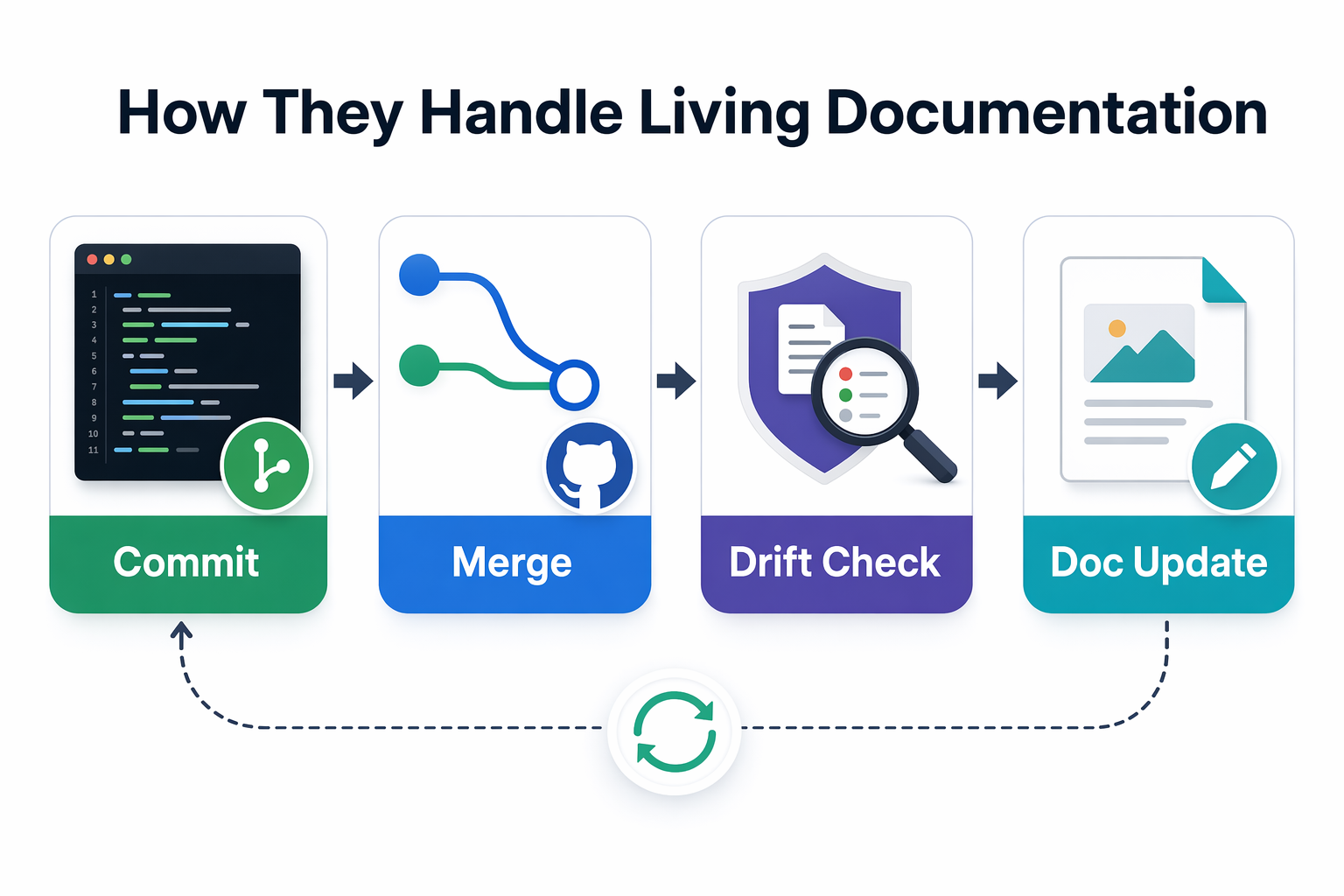
Synchronization usually happens at a few workflow points:
- During pull requests - catch drift before merge.
- At merge time - refresh docs from the new main branch state.
- When AI agents need context - serve current repo knowledge, not stale summaries.
The key difference is simple: generated docs are useful, but continuously reconciled docs are what keep humans and agents aligned.
Also Read: Moxie Docs vs DeepDocs: Which AI Documentation Tool Wins?
AI Code Standards and Agent Readiness#
Why conventions need to be machine-readable
Teams already write standards. The problem is that most standards live in wikis, old PR comments, or tribal memory. Agents cannot use that well. They need rules in a form they can fetch, parse, and apply during work.
NIST’s recent work on AI documentation stresses the need for structured templates and clearer, more actionable documentation artifacts in its 2025 zero-draft outline.
- Good machine-readable conventions usually cover:
- naming rules
- repo structure
- API patterns
- test requirements
If a rule cannot be passed to an agent as context, it will drift fast.
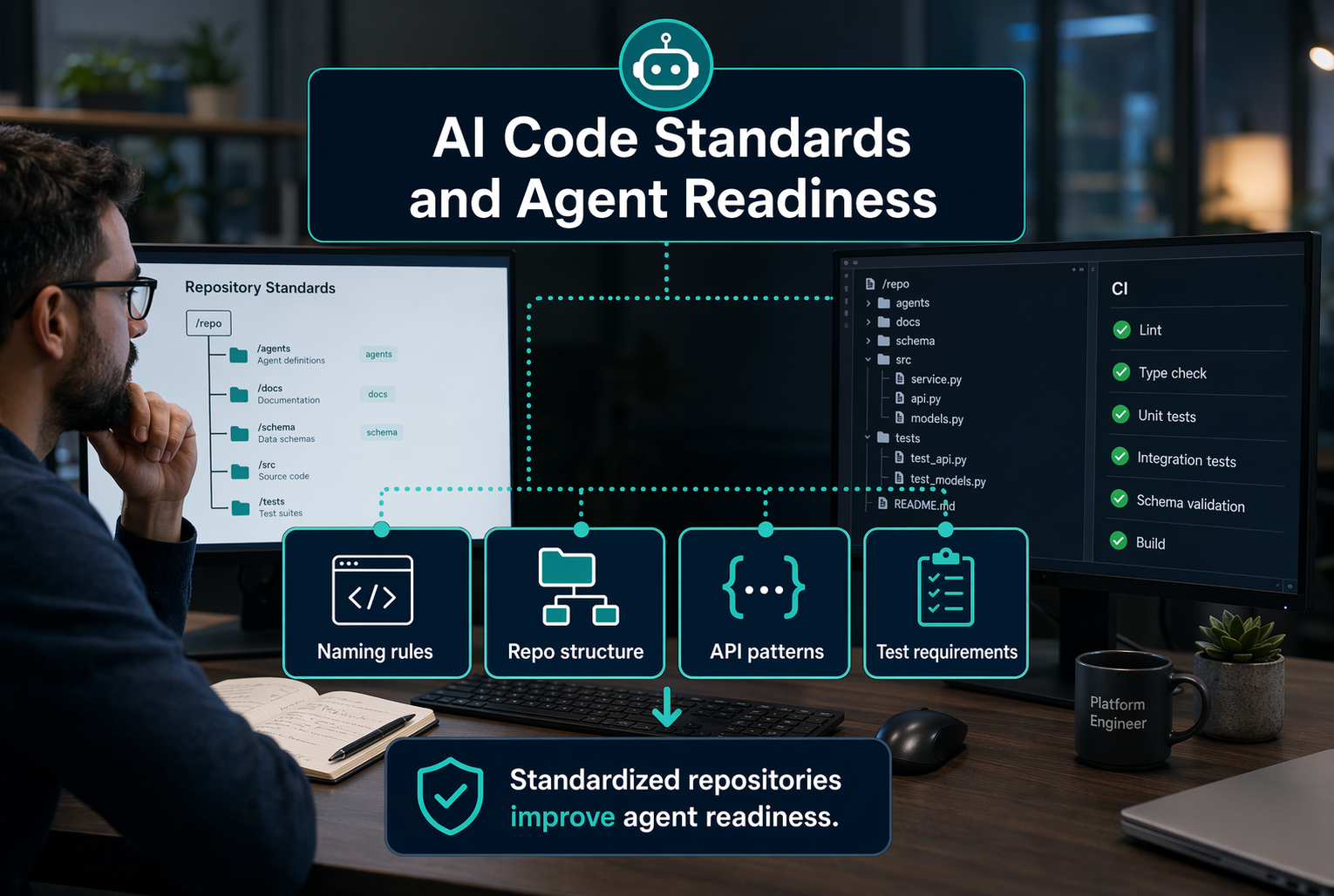
Prompting versus context delivery
Prompting alone is weak. A long system prompt may say “follow our standards,” but the agent still lacks the exact repo facts, current patterns, and safe boundaries. That is where context delivery matters more than clever phrasing.
OWASP notes that prompt injection can alter model behavior in unsafe ways, especially when models take in outside content or tool output through direct or indirect prompt injection paths.
Use this simple split:
- Prompting tells the agent how to behave.
- Context delivery gives the agent the right repo truth.
- Policy controls limit what the agent can do.
That is why Moxie Docs fits this layer well. It helps deliver living code conventions and current repository context, instead of hoping one static prompt keeps agents aligned.
Also Read: Automated Code Documentation That Kills Onboarding Debt
Documentation Outputs: Depth Versus Breadth#
When broad artifact coverage matters#
DocuWriter.ai fits teams that need many output types from one platform. Its product pages say it can generate API docs, README files, architecture docs, UML diagrams, full documentation trees, and file-level codebase docs across multiple generators. That breadth helps when one buyer owns docs for onboarding, handoff, compliance, and external developer use at the same time.
- Good fit for teams that want:
- Many doc formats from one repo
- Workspace features for sharing and export
- Broader coverage beyond engineering-only docs
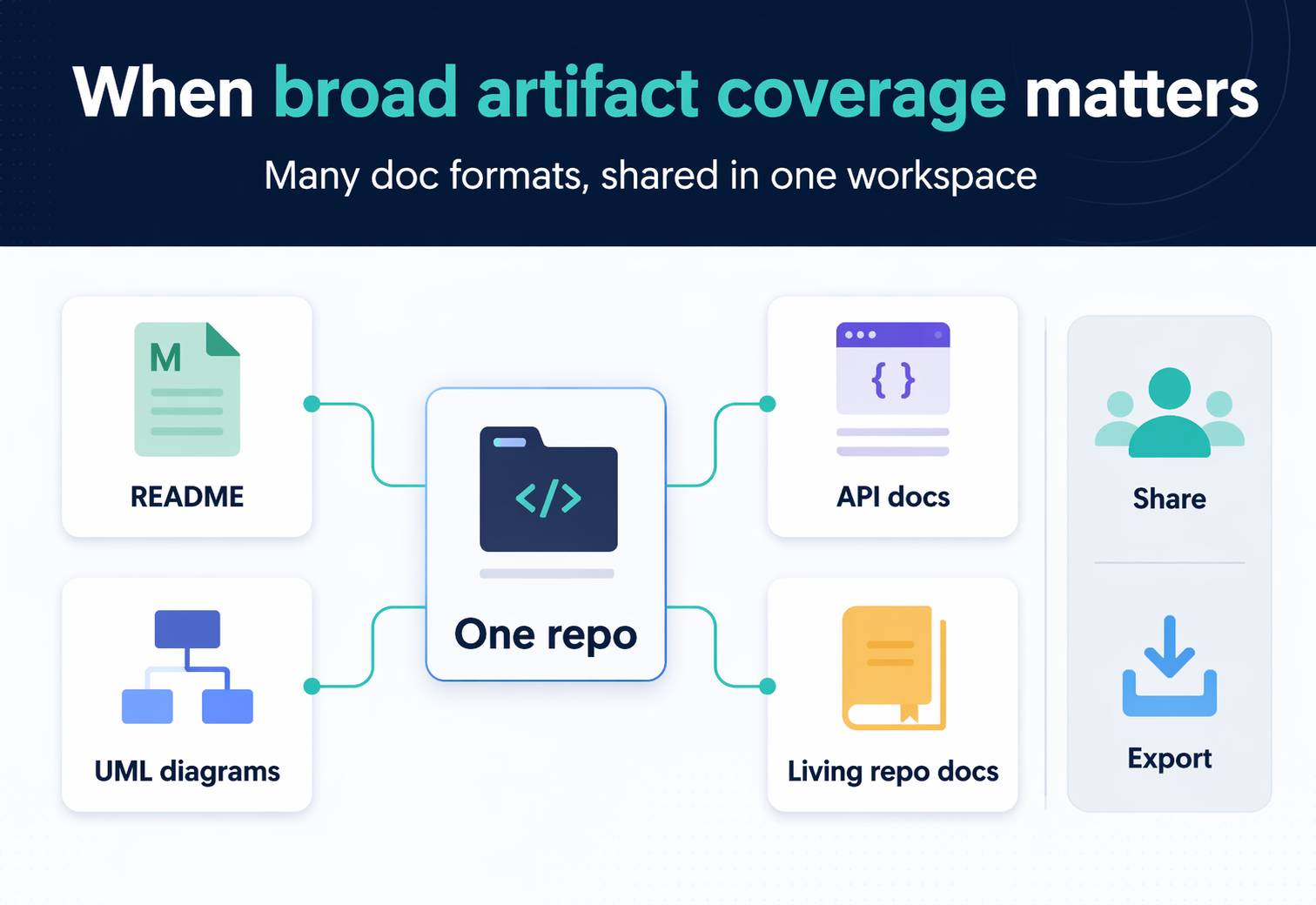
Breadth helps if your main problem is producing more artifacts faster.
When fewer, stronger docs outperform many outputs#
Moxie Docs makes more sense when your team cares less about output count and more about trustworthy repo knowledge. Broad generation is useful, but too many artifacts can spread attention thin. In contrast, living docs tied to merges can keep the key docs current and reduce drift. DocuWriter.ai itself frames one path as generating “full documentation trees” and separate file-level docs in a Space for team review and export.
- Fewer, stronger docs win when:
- Developers need current conventions
- AI agents need clean repo context
- Leaders want less stale documentation debt
If your biggest pain is drift, depth beats volume.
Collaboration, Governance, and Workflow Fit#
Review gates and change control matter more once AI starts writing larger chunks of code. IBM defines code governance as the rules and controls for how code is written, reviewed, approved, and maintained, which fits this buying decision well IBM’s code governance overview. Moxie Docs fits teams that want:
- docs updated with every merge
- visible drift signals before bad context spreads
- tighter PR review around conventions and repo truth
DocuWriter.ai is better if your process starts with broad doc generation, not strict merge-time control.
Pick Moxie Docs if your team treats documentation as part of change control, not a cleanup task.
Scaling knowledge across teams is where the gap gets clearer. Microsoft’s Well-Architected guidance says teams should formalize development practices across the full lifecycle and make them transparent to stakeholders Microsoft guidance. In practice:
- Moxie Docs helps platform and product teams share current repo knowledge with both humans and agents.
- DocuWriter.ai helps centralize more document outputs across a workspace.
- Workflow fit depends on whether you need living repo context or broader documentation operations.
Also Read: Ai Code Assistants And Living Documentation In 2026
Which Should You Choose: Moxie Docs or DocuWriter.ai?#
Choose Moxie Docs if your main pain is drift. Its pitch is simple: keep repository docs current on every merge, catch doc drift, and feed live codebase context to AI agents over MCP, according to the Moxie Docs overview. That fits teams where docs break because the code moves fast.
- Best for platform teams
- Strong fit for GitHub-first workflows
- Better when you want a living source of truth, not just generated pages
If stale architecture docs slow reviews, onboarding, or agent output, Moxie Docs is the safer bet.
Choose DocuWriter.ai if your main pain is output volume. It is broader by design. The platform offers code docs, API specs, UML diagrams, test generation, release notes, Spaces, and repo sync, based on DocuWriter.ai features. That makes sense when your team needs many documentation artifacts from one workspace.
- Pick it for multi-output generation
- Pick it if you want built-in workspace management
- Pick it if diagrams, tests, and export options matter as much as docs
DocuWriter.ai is stronger when you need one platform to produce many deliverables across teams.
The simplest rule of thumb:
| If your problem is... | Choose... | Why |
|---|---|---|
| Docs drift from code | Moxie Docs | It is built to keep repo knowledge fresh |
| You need many doc outputs fast | DocuWriter.ai | It covers more artifact types in one platform |
Also Read: 8 Top AI Documentation Tools for Engineering Teams in 2026
If you need AI code conventions that stay true to your repo, try Moxie Docs. It keeps docs current, flags drift, and gives agents real code context so your team ships with less guesswork.
Frequently Asked Questions#
Q1: How does Moxie Docs ensure real-time synchronization of documentation with evolving codebases compared to DocuWriter.ai?#
Moxie Docs updates docs with each merge and flags drift as repos change. DocuWriter.ai is stronger at generating docs on demand, but Moxie Docs is built to keep repository knowledge current over time.
Q2: What differentiates Moxie Docs from DocuWriter.ai in automating code documentation and maintenance workflows?#
Moxie Docs focuses on living docs, convention tracking, and repo truth. DocuWriter.ai covers broader document outputs and workspace tasks. Pick Moxie Docs if your main pain is stale internal docs after fast code changes.
Q3: How do AI code conventions implemented by Moxie Docs improve developer productivity versus DocuWriter.ai?#
Moxie Docs gives both engineers and AI agents shared rules, current context, and less guessing. That cuts rework, token waste, and context switching. DocuWriter.ai helps produce assets, but Moxie Docs better supports day-to-day coding flow.
Q4: Which team gets more value from Moxie Docs?#
Teams with many repos, frequent merges, and AI-assisted coding get the most value. If your issue is keeping internal knowledge accurate without manual cleanup, Moxie Docs usually fits better than a broader doc generator.
Conclusion#
Moxie Docs and DocuWriter.ai solve different problems well. Moxie Docs fits teams that need living repository knowledge, tighter AI code conventions, and docs that stay close to code. Its product pages stress continuous repo indexing, drift checks, and MCP context for agents on the main site. DocuWriter.ai is the better fit if you want a broader generator suite for docs, tests, UML, and workspace features, as shown on its platform overview. For engineering leaders, the choice is simple: pick Moxie Docs for durable codebase context, and pick DocuWriter.ai for wider output generation.
Republish or cite this article
You're welcome to republish this piece in full or in part. We just ask that you credit the original with a link back. See our republishing guidelines.
Attribution snippet
<p>This article was originally published on <a href="https://moxiedocs.com/blog/ai-code-conventions-how-moxiedocs-compares-to-docuwriter-ai">Moxie Docs</a>.</p>Cite this article
The Moxie Docs team. "AI Code Conventions: How Moxie Docs Compares to DocuWriter.ai." Moxie Docs, June 25, 2026, https://moxiedocs.com/blog/ai-code-conventions-how-moxiedocs-compares-to-docuwriter-ai.
Read next
Documenting APIs for AI Agents: OpenAPI, llms.txt, and MCP, and When Each One Matters
AI agents now read your API docs before developers do. What OpenAPI, llms.txt, Markdown pages, and an MCP server each give an agent, which one to build first, how to write descriptions an agent can act on, and how to keep all of them in sync with the code.
Developer Onboarding Documentation Review: Is MoxieDocs Worth It?
Struggling with slow developer onboarding? We tested MoxieDocs and found out if it cuts ramp-up time by 30%—plus its hidden perks for GitHub maintainers.