
AI Code Conventions in 2026: Emerging Trends and Industry Insights
Discover the latest AI code standards and emerging trends in 2026 shaping the industry. Insights for engineering teams, developers, and tech decision-makers.
- industry-trends
- ai-agents
Quick Summary: By 2026, AI code standards are essential for maintaining quality, traceability, and trust as AI-generated code becomes mainstream. Teams are moving from ad hoc prompts to shared rules, with governance, verification, and responsible AI integrated into style guides and review processes. Clear ownership, automated checks, and documentation are now critical to control risks and ensure sustainable development.
AI Code Standards are now an operating need, not a side project. Surveys from Stack Overflow, Sonar, GitLab, and New Relic show AI already writes or heavily assists a growing share of production code. The gap is clear: teams can generate code fast, but many still lack solid AI Code Standards for review, proof, and release control.
That raises real risk. Faster output can weaken traceability, break a Programming Style Guide, increase review load, and add technical debt that stays hidden until later. Code Convention Trends now matter at the team and org level.
This article grounds AI Code Standards in current industry data and shows how leading teams are setting project rules, governance, checks, and responsible use standards in 2026.
AI Code Standards Are Becoming the New Baseline#
AI adoption is already mainstream#
AI coding is not a side experiment anymore. It is part of normal software work. Stanford HAI reports that 88% of surveyed organizations used AI in 2025, and 70% used generative AI in at least one business function according to the 2026 AI Index economy findings. That changes the job for engineering leaders.
When AI touches daily commits, teams need a shared baseline for:
- review rules
- traceability
- test coverage
- doc updates
Without that, code quality starts to drift team by team.
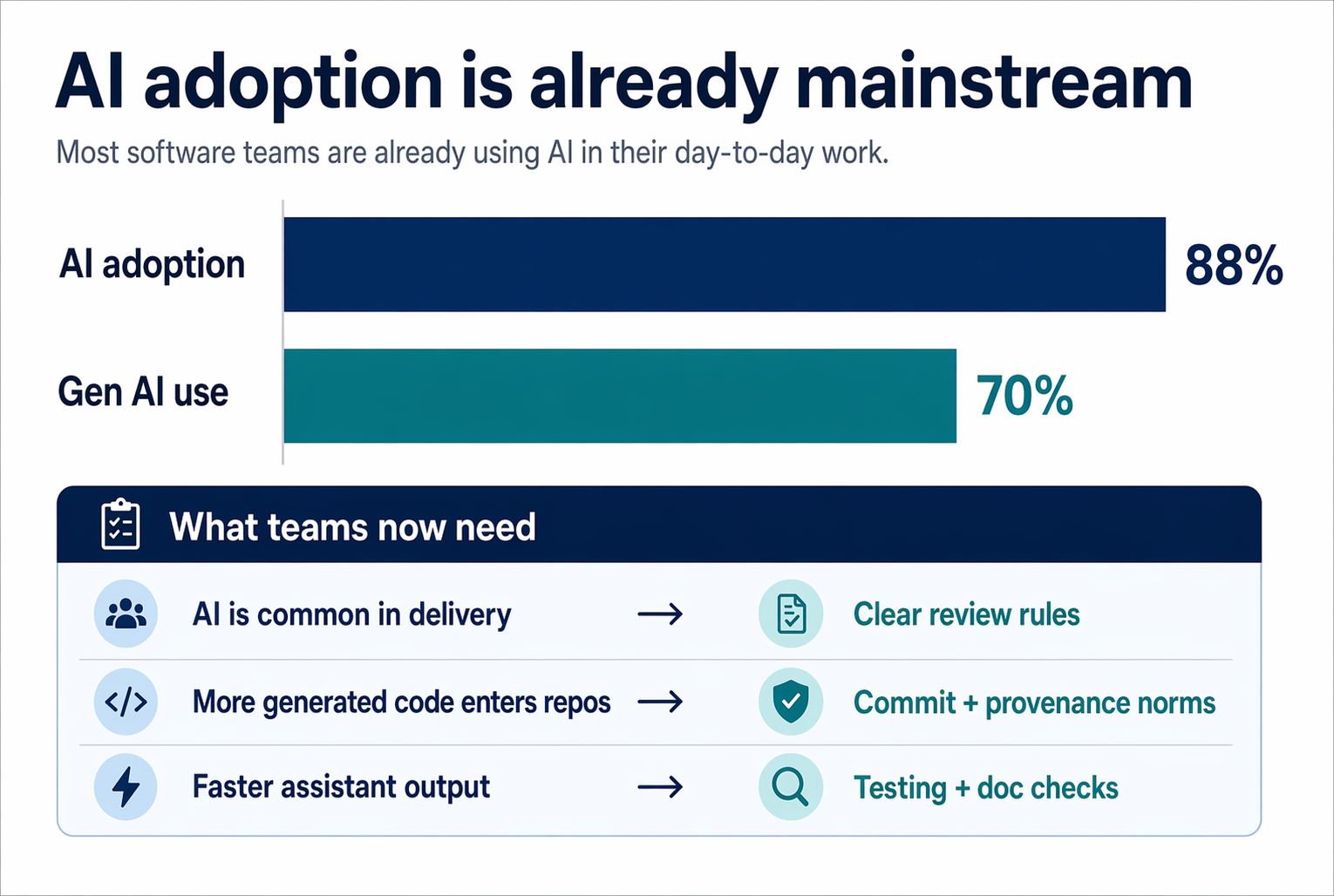
A simple view helps:
| Shift in 2026 | What teams now need |
|---|---|
| AI is common in delivery | Clear AI code review rules |
| More generated code enters repos | Strong commit and provenance norms |
| Faster output from assistants | Tighter testing and documentation checks |
Once AI use is mainstream, standards stop being optional process work. They become basic engineering hygiene.
Trust is the bottleneck, not usage#
The bigger problem now is not whether teams use AI. It is whether they trust what gets merged. McKinsey says security and risk concerns are the top barrier to scaling agentic AI in its 2026 AI trust survey.
That is why AI code conventions are getting stricter:
- Tag AI-assisted changes
- Require human ownership
- Link code to tests and docs
Tools like Moxie Docs fit here because trust improves when docs stay in sync with fast-moving code.
Also Read: Ultimate Guide to Auto Documentation for Development Teams
Project-Level Rules Are Replacing One-Off Prompts#
One-off prompts still help with small tasks. They fail when AI touches many files over weeks. A 2025 study of 401 open-source repos found teams are now writing persistent rule files with shared context for conventions, examples, and project constraints in developer-provided context for AI coding assistants.
Why consistency matters more with AI#
AI speeds up output, but it also speeds up drift. Two engineers can ask for the same feature and get different naming, layout, tests, and error handling. That slows review and makes ownership fuzzy.
If the model sees no project rules, it fills gaps with internet-average habits, not your team’s standards.
Teams are fixing this by moving rules from chat history into the repo itself. Stack Overflow notes that AI coding guidelines need to be more explicit than human onboarding docs, because agents lack tacit team context in shared coding guidelines for AI agents.

What belongs in a modern programming style guide#
A good AI-ready style guide should define the basics in plain words:
- Naming rules for files, classes, variables, and tests
- Approved patterns for logging, errors, validation, and API design
- Architecture boundaries so agents do not invent new layers
- Testing minimums for unit, integration, and edge cases
| Rule area | What to specify | Why it matters |
|---|---|---|
| Style | Formatting, naming, comments | Cuts review noise |
| Structure | Folder layout, module boundaries | Prevents random sprawl |
| Quality | Test expectations, lint gates | Keeps generated code shippable |
Moxie Docs fits here because living docs keep those rules tied to the real codebase, not a stale wiki page.
Also Read: Ai Code Assistants And Living Documentation In 2026
Verification and Governance Are the New Quality Gates#
The review queue is the new bottleneck#
AI sped up code creation. It did not speed up trust. GitLab’s 2026 AI Accountability Report found that 85% of teams say AI has shifted the bottleneck from writing code to reviewing and validating it, while 79% say overall delivery has not sped up at the same pace as developer output, according to GitLab’s 2026 report.
![How to create Quality gates on Sonarqube [Latest 2024]](
)
That changes what a “quality gate” means. Teams now need checks that scale better than manual review:
- Automated verification for security, tests, and dependency risk
- Clear ownership for AI-touched pull requests
- Fast traceability so reviewers know what changed and why
If reviewers cannot tell which code came from AI, they cannot review risk with the right level of care.
| Old gate | New gate |
|---|---|
| Style and syntax | Provenance and validation |
| Manual PR review | Automated review plus human sign-off |
| Merge confidence | Runtime and policy confidence |
Governance and traceability are now board-level concerns#
This is no longer just an engineering workflow issue. It is a risk and audit issue. Grant Thornton’s 2026 survey says 78% of executives lack strong confidence they could pass an independent AI governance audit within 90 days, and many boards still have not set clear AI oversight expectations, per Grant Thornton’s 2026 AI Impact Survey.
NIST already gave teams the shape of the answer:
- Govern who owns the risk
- Map where AI is used
- Measure failure and drift
- Manage fixes and proof
For software teams, that means:
- keeping decision logs
- tagging AI-generated changes
- storing review evidence
- maintaining living docs as code shifts
Tools like Moxie Docs fit here because drift is a governance problem, not just a docs problem. If the code changes and the docs do not, your audit trail is already weak.
Responsible AI Is Moving Into the Style Guide#
Security and maintainability are part of the convention set#
Style guides now cover more than naming and format. Teams are adding rules for AI-generated code so speed does not break trust. The OWASP cheat sheet warns that modern coding agents can run commands, edit files, and act with broad permissions, so secure review can no longer sit outside the coding convention set OWASP secure coding guidance.
- Common rules now include:
- verify AI-suggested packages before install
- block secrets in prompts and output
- require tests and dependency scans on AI-written changes
- document why a risky suggestion was kept
| Convention area | What teams now enforce |
|---|---|
| Dependencies | Check age, source, and known flaws |
| Reviews | Flag AI-touched files for extra scrutiny |
| Docs | Record assumptions and generated changes |

If a rule matters in CI, put it in the style guide too. That is how conventions become daily habits.
Responsible AI is now an everyday coding expectation#
Responsible AI has moved from policy decks into pull requests. NIST says generative AI risk work should cover governance, measurement, and management across the full AI lifecycle NIST GenAI profile. For engineering teams, that turns into plain coding rules:
- State when AI use is allowed.
- Label sensitive repos and banned inputs.
- Require human sign-off for high-risk changes.
- Keep living docs current as rules change.
Moxie Docs fits here because teams need conventions, decisions, and repo-specific guardrails to stay visible after every merge.
Also Read: How To Sync Documentation With Github And Keep It Alive As Your Codebase Evolves
What Developers Need to Do Differently in 2026#
Teams need shared prompts, rules, and review criteria#
Solo AI habits do not scale. In 2026, teams need a shared playbook for how AI writes code, tests, docs, and PR notes. GitLab found that 80% of organizations adopted AI tools faster than they built policies, and 92% reported governance problems with AI-generated code in its 2026 accountability report.
Use one simple standard:
- Approved prompt patterns
- Repo-level coding rules
- PR labels for AI-written changes
- Review checks for logic, tests, and context
| Team need | What to standardize | Why it matters |
|---|---|---|
| Prompting | Reusable prompt templates | Cuts random output |
| Review | AI-specific checklist | Catches plausible mistakes |
| Ownership | Named human approver | Keeps accountability clear |
If the team cannot explain how AI code gets reviewed, the process is not ready.
Measure the work AI actually creates#
Velocity is not enough anymore. Stack Overflow’s 2025 survey shows 69% of AI agent users say productivity went up, but only 17% say collaboration improved in the survey results. That gap matters.
Track the hidden load AI adds:
- Review time per PR
- Rework after merge
- Incident rate on AI-touched code
- Doc drift after release
A short scorecard helps:
- Output - code shipped
- Verification - review and test effort
- Stability - bugs, rollback, hotfixes
Moxie Docs fits here because teams also need to measure whether generated docs stay true as code changes. If code moves fast but context goes stale, AI output gets worse on the next cycle.
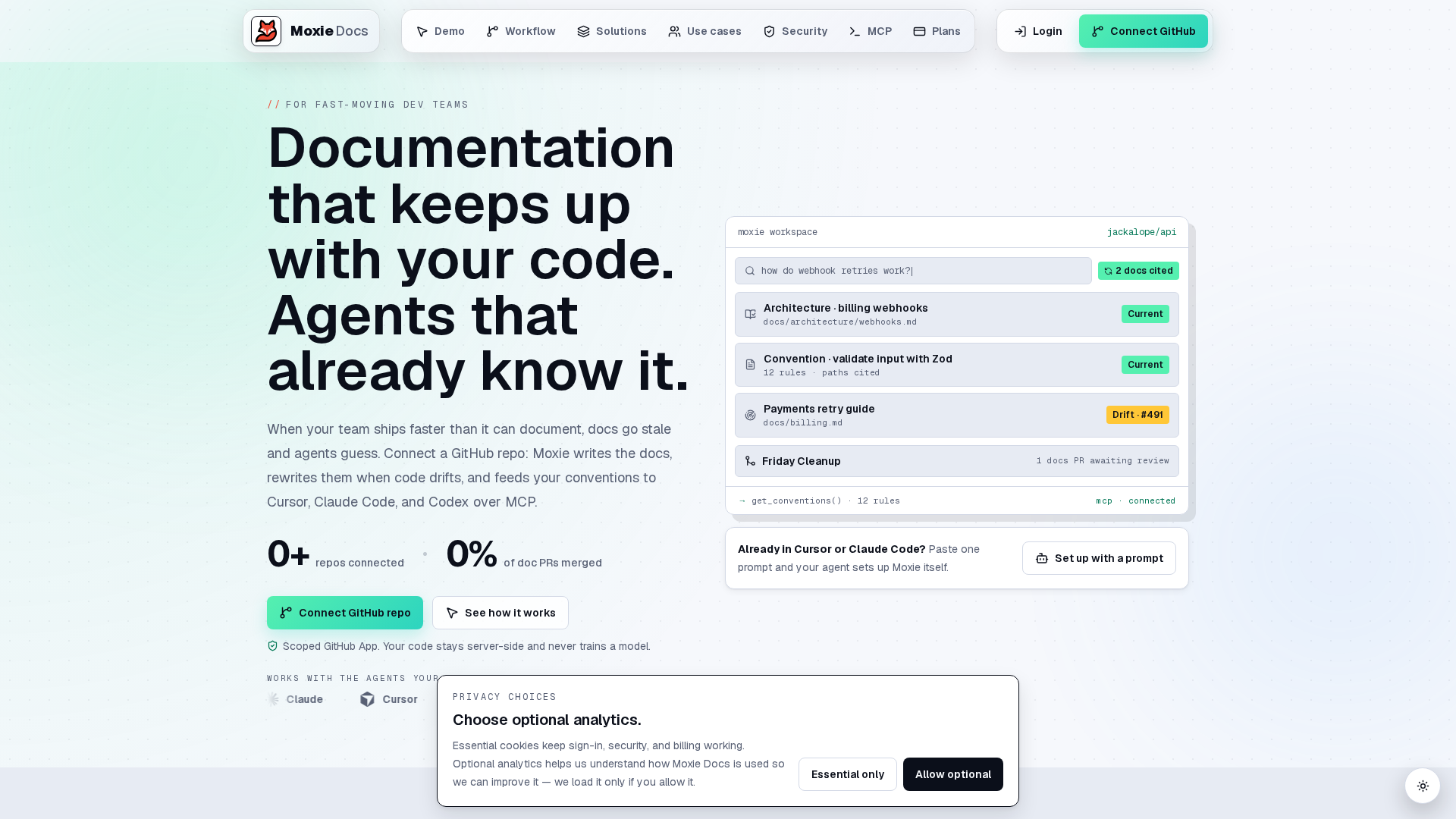
Set AI code conventions your team can actually keep. Moxie Docs keeps GitHub docs in sync with every merge, flags drift fast, and gives AI coding agents real codebase context. If you want cleaner standards, fewer review loops, and less token waste, start there.
Frequently Asked Questions#
Q1: What emerging AI code conventions will define software development practices in 2026?#
Teams now expect prompt traceability, AI-authored commit labels, stricter test-before-merge rules, and short inline notes that explain human review decisions. Many also require source tagging for generated code, plus clear ownership when AI suggests risky refactors.
Q2: How do industry insights predict AI will transform code review patterns in 2026?#
Reviews are getting faster, but not lighter. Teams use AI to catch style drift, dead code, and missing tests first. Human reviewers spend more time on logic, security, and business risk, which changes review checklists and approval rules.
Q3: What are the key trends in AI coding for enterprise teams according to 2026 industry reports?#
Big teams are standardizing approved AI workflows, audit logs, and repo-level guardrails. Documentation is also moving into the workflow. Tools like Moxie Docs fit here because they keep docs synced as AI changes code, which cuts drift.
Q4: How should teams start updating their coding standards for AI-generated code?#
Start small:
- Mark AI-assisted changes.
- Require tests for generated code.
- Add review rules for security and data access.
- Define when engineers must rewrite AI output.
Keep the policy short, or people will ignore it.
Conclusion#
AI code conventions in 2026 are no longer just style rules. They are control rules. Teams now need clear standards for naming, prompt traceability, review depth, test coverage, dependency checks, and ownership after merge.
The big shift is simple:
- AI speeds up drafting
- Humans still own judgment
- Governance decides whether speed helps or hurts
Recent data backs that up. GitLab found 80% of organizations adopted AI tools faster than policies, and 92% report governance challenges with AI-generated code, according to its AI Accountability Report. Black Duck also reports 97% enterprise adoption and shows teams with full governance are more likely to see strong efficiency gains in its 2026 study.
The winning convention set in 2026 is not “write more code.” It is write code you can verify, explain, and maintain.
Republish or cite this article
You're welcome to republish this piece in full or in part. We just ask that you credit the original with a link back. See our republishing guidelines.
Attribution snippet
<p>This article was originally published on <a href="https://moxiedocs.com/blog/ai-code-conventions-in-2026-emerging-trends-and-industry-insights">Moxie Docs</a>.</p>Cite this article
The Moxie Docs team. "AI Code Conventions in 2026: Emerging Trends and Industry Insights." Moxie Docs, June 24, 2026, https://moxiedocs.com/blog/ai-code-conventions-in-2026-emerging-trends-and-industry-insights.
Read next
llms.txt Explained: How to Write, Validate, and Keep One Accurate
llms.txt is a small Markdown file that tells AI agents which pages on your site matter. What the v2 spec requires, a worked example, the mistakes validators catch, how to serve it, and why the file quietly goes stale.
7 AI Code Conventions That Keep Models and Teams Aligned
Discover essential AI code conventions that ensure models and development teams stay aligned, improving efficiency and consistency across AI projects. Practical strategies for engineering leaders and teams adopting AI.