
Moxie Docs vs DeepDocs: Which AI Documentation Tool Wins?
Compare Moxie Docs and DeepDocs to find the best AI documentation tool for software teams, technical writers, and AI developers. Discover features and insights to make an informed choice.
- industry-trends
- documentation
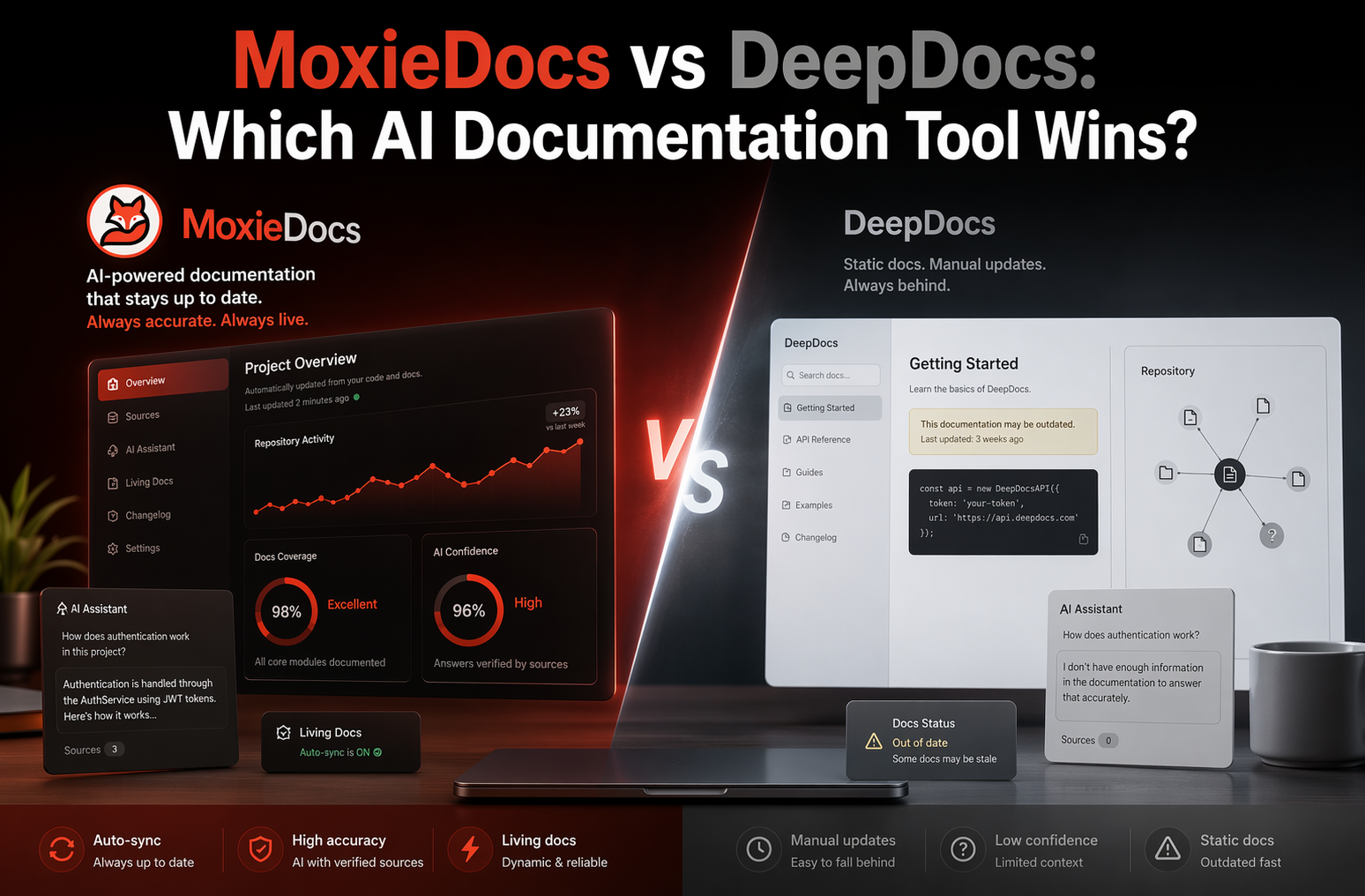
Quick Summary: Moxie Docs is better for teams needing live, up-to-date documentation with AI context, especially when working with active codebases. DeepDocs suits teams focused on maintaining existing docs within GitHub with minimal updates. Overall, Moxie Docs offers more automation, drift detection, and cleaner AI integration, making it ideal for dynamic projects. Moxie Docs leads for teams that need live, repo-aware docs and AI agent context. DeepDocs fits better if you mostly want GitHub docs synced with code changes. Teams now compare AI Documentation Tools, Code Documentation Software, and Live Documentation Tools because code moves faster than docs. I review AI Documentation Tools often, and this guide compares workflow fit, upkeep, pricing, automation, and AI usefulness across AI Documentation Tools.
Moxie Docs vs DeepDocs: At a Glance#
| Moxie Docs | DeepDocs | |
|---|---|---|
| Automation model | Indexes repos, generates docs, and opens cleanup PRs | Updates docs automatically on PRs |
| Best for | Live repo docs and AI coding-agent context | Maintaining existing docs in GitHub |
| AI agent context | MCP-based repository conventions and docs | Doc update automation, not MCP context |
| Pricing model | Flat repo-based tiers | Free plan, paid upgrade path |
| Docs maintenance style | Continuous sync with drift detection | Minimal, style-preserving edits |
How Moxie Docs and DeepDocs Compare#
Moxie Docs#
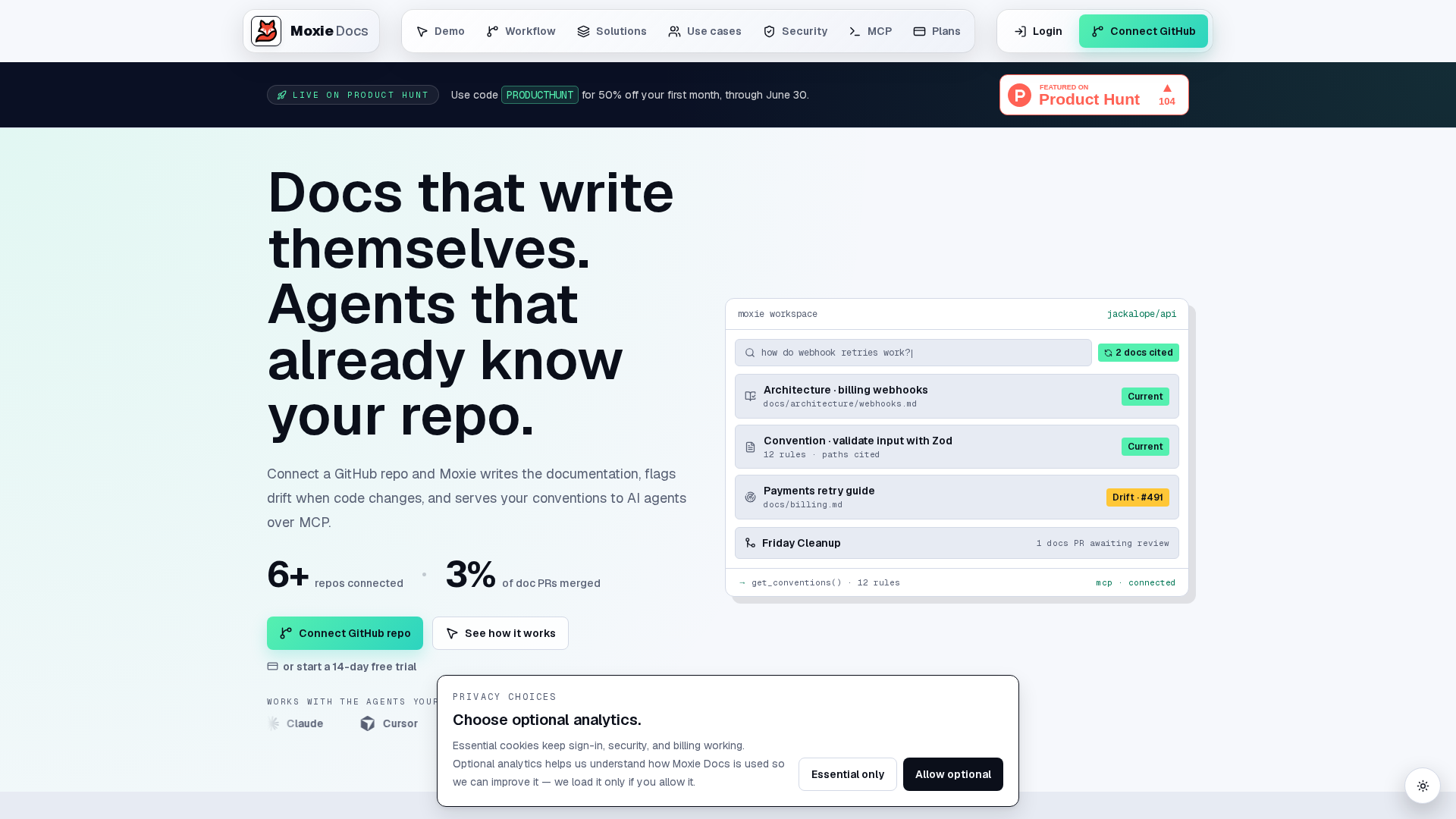
Moxie Docs is a hosted GitHub docs platform built for teams that need living docs plus AI-agent context. It indexes repos, detects drift, and serves repo conventions over MCP, so it fits teams using agents alongside human writers.
 Key strengths
- Continuous sync with drift detection
- MCP-based repo context for AI agents
DeepDocs#
DeepDocs is a GitHub-native AI agent focused on keeping existing docs in sync with code and PRs. It suits teams that already have docs in place and want minimal, style-preserving updates inside their GitHub flow.
 Key strengths
- Automatic doc updates on PRs
- Minimal edits that preserve existing style
Automation Depth and Workflow Fit#
DeepDocs automates doc upkeep well. It updates docs on pull requests, preserves structure, and works inside GitHub flows, based on its product page. In practice, that fits teams that already know which docs matter and mainly want fewer stale pages.
Moxie Docs goes further. It not only updates affected docs after merges, but also detects drift, keeps a searchable knowledge base current, and serves repo context to AI agents over MCP, per the Moxie Docs FAQ.
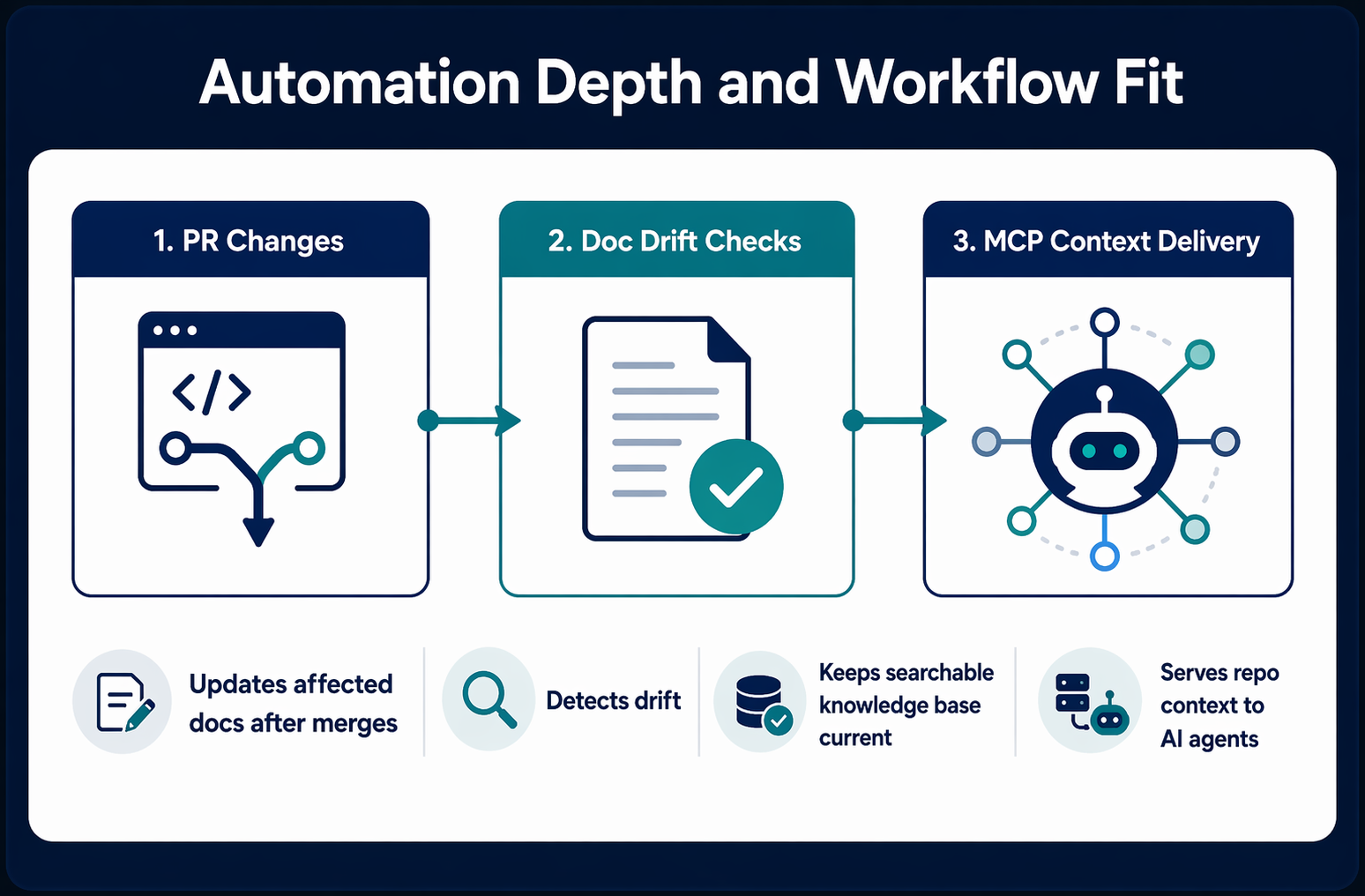
Automation is enough when your problem is simple: keep READMEs, guides, and refs synced with code changes. Context matters when engineers and agents need architecture, conventions, and reliable answers across a moving codebase.
For implementation teams, the fit is clear:
- Choose DeepDocs for narrow doc-sync automation
- Choose Moxie Docs for living docs plus agent-ready context
- Favor Moxie Docs if onboarding, review speed, and AI output quality all matter
Also Read: Living Documentation and AI Documentation: A Comparative Overview
Pricing, Maintenance, and Team Overhead#
-
How pricing changes as the team grows: Costs rarely scale in a straight line. Bigger teams create more reviews, handoffs, and sync work. Brooks's law says adding people can increase communication load and slow delivery The Mythical Man-Month. Moxie Docs tends to hold value better here because living docs cut repeat questions and stale page cleanup.
-
Operational burden after installation: The real cost starts after setup. Software maintenance often takes most lifecycle cost, and testing can consume much of that work Software maintenance. DeepDocs may need more manual checking if teams want docs to stay current. Moxie Docs lowers overhead by updating docs with each merge and catching drift early.
Also Read: 8 Top AI Documentation Tools for Engineering Teams in 2026
AI Coding Agents, Token Efficiency, and Developer Experience#
Why live context beats repeated repo crawling Live context wins because agents stop re-reading the same repo state every turn. GitHub says prompt caching and loading tools only when needed cuts repeated context overhead in long sessions, while its workflow team found trimming unused MCP tools saved thousands of tokens per run in tests GitHub’s context handling update GitHub’s token efficiency report.

Developer experience for maintainers and writers Maintainers need fewer context resets. Writers need docs that track merges, not stale summaries. Moxie Docs fits that better than tools focused on one-time generation because it keeps living documentation aligned with code and gives AI agents cleaner, smaller, more useful context.
Also Read: Ultimate Guide to Auto Documentation for Development Teams
Which Should You Choose: Moxie Docs or DeepDocs?#
Choose Moxie Docs if you need living docs and agent context#
Choose Moxie Docs if your team wants docs that stay current and also help AI agents work with real repo context. Moxie Docs keeps a searchable knowledge base in sync and serves conventions and docs over MCP, according to Moxie Docs and its AI engineer page.
Choose DeepDocs if you mainly need doc maintenance#
Choose DeepDocs if your main goal is simple doc upkeep inside GitHub PRs. DeepDocs focuses on updating existing docs, preserving structure, and keeping files in sync with code changes, based on DeepDocs and its documentation intro.
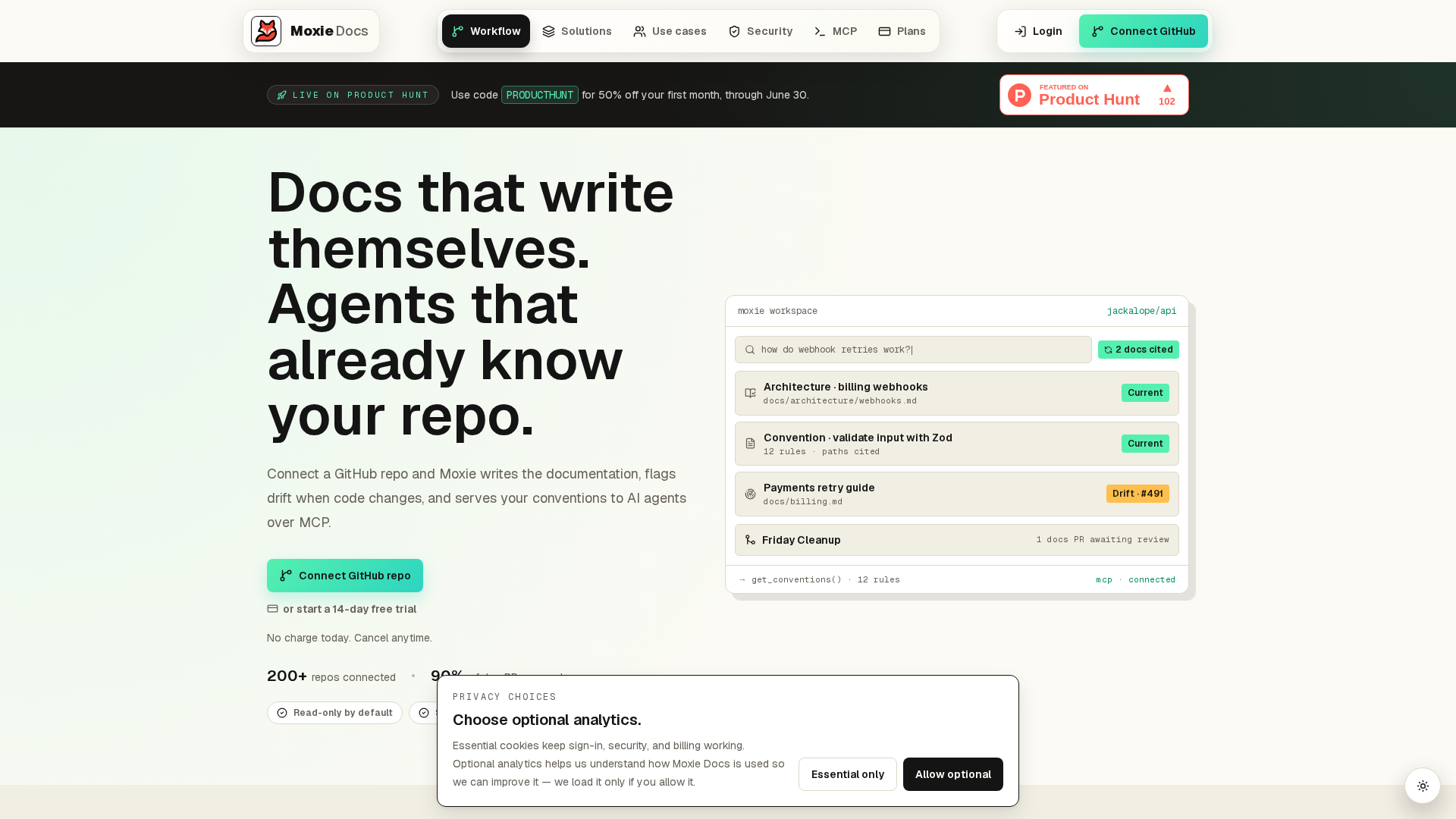
Choose Moxie Docs if you want docs that stay accurate and useful for both humans and AI agents. Start with your GitHub repo and cut doc drift fast.
Frequently Asked Questions#
Q1: How does Moxie Docs improve real-time synchronization of documentation for GitHub repositories compared to DeepDocs?#
Moxie Docs updates docs with each merge, flags drift fast, and keeps repo knowledge current. DeepDocs helps automate docs, but Moxie Docs is stronger when teams need docs to stay synced with active code changes.
Q2: What are the advantages of Moxie Docs's live documentation maintenance over DeepDocs's open-source platform?#
Moxie Docs gives teams less manual cleanup, clearer change tracking, and more reliable living docs. That matters when many engineers ship often and stale docs slow reviews, onboarding, incident response, or AI-assisted coding.
Q3: In what scenarios does Moxie Docs reduce token waste better than DeepDocs for AI coding agents?#
Moxie Docs works best when AI agents need fresh codebase context during rapid releases, large refactors, or multi-service work. Better context means fewer repeated prompts, less irrelevant repo scanning, and cheaper agent runs.
Conclusion#
Moxie Docs wins for teams that need living docs and agent-ready context. AI repo docs remain an open challenge, as CodeWiki research notes, while GitHub's tooling trend shows growing demand for documentation tied to AI agents.
Republish or cite this article
You're welcome to republish this piece in full or in part. We just ask that you credit the original with a link back. See our republishing guidelines.
Attribution snippet
<p>This article was originally published on <a href="https://moxiedocs.com/blog/moxiedocs-vs-deepdocs-which-ai-documentation-tool-wins">Moxie Docs</a>.</p>Cite this article
The Moxie Docs team. "Moxie Docs vs DeepDocs: Which AI Documentation Tool Wins?." Moxie Docs, June 21, 2026, https://moxiedocs.com/blog/moxiedocs-vs-deepdocs-which-ai-documentation-tool-wins.
Read next
Stop Writing Novels in Your Wiki: A Minimal Internal Developer Documentation Template That Survives Change
Why wiki pages rot in fast codebases and how a lightweight, git-backed internal developer documentation template keeps docs accurate without busywork.
Context Engineering for Coding Agents: A Field Guide
Coding agents fail on context, not capability. A practical guide to context engineering for a real repository: the four layers, a token budget you can reason about, how to diagnose which layer is failing, and how to keep it from going stale.