How to Detect Documentation Drift with Automated Tools in 2026
Discover practical strategies for identifying documentation drift using automated tools. Essential for software teams aiming to maintain accurate, up-to-date technical content efficiently.
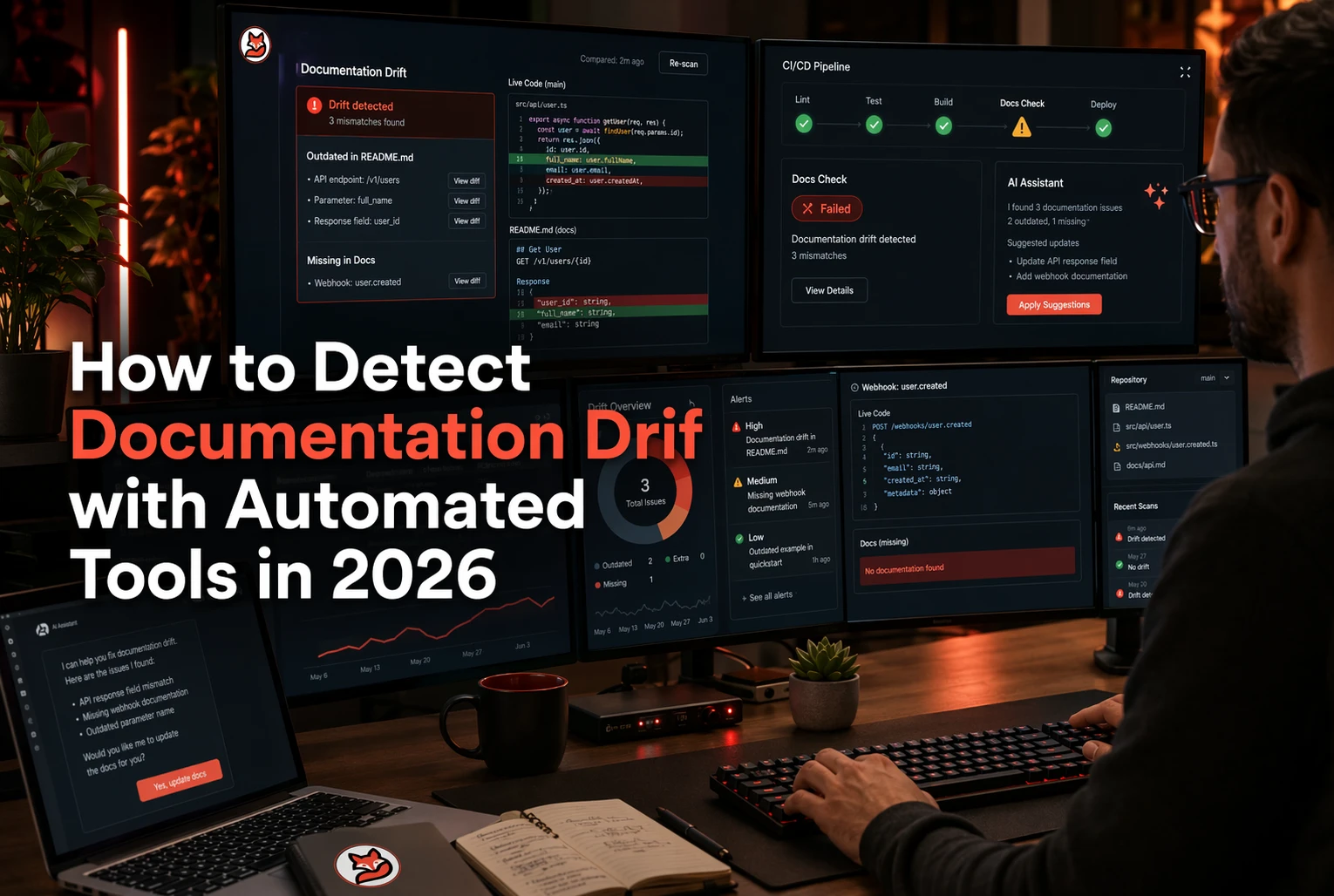
Quick Summary: Automated tools can detect documentation drift by comparing docs with code, configs, and API schemas before release. Combining deterministic checks for broken references with semantic reviews for content accuracy helps catch gaps early. Integrating these checks into CI workflows ensures docs stay synchronized with code changes, reducing errors and building trust.
A PR swaps x-api-key for Authorization, but the docs still show the old header. That kind of drift breaks integrations fast. This guide shows how to catch those gaps before release with automated checks in CI, semantic validation, and ongoing monitoring. It is built for teams that ship often and cannot rely on manual doc reviews. The approach here is practical, vendor-neutral, and based on workflows engineering and docs teams can run without heavy setup.
Step 1: Map what drift you actually want to detect#
Start by naming the drift types you care about. Teams usually mix three: reference drift like broken paths or flags, behavior drift like wrong defaults, and structure drift like stale architecture maps. Tools such as Staleguard split deterministic checks from semantic checks for this reason.

Set a pass-fail line before you automate anything. NIST recommends automated testing and static analysis as core verification methods in modern software pipelines, which fits doc drift checks too NIST guidance. Use a simple rule set:
- fail on broken commands, paths, env vars
- warn on likely semantic mismatch
- ignore style-only edits
Pick the sources that matter most:
- README and setup guides
- API docs and runbooks
- ADRs, architecture docs, and agent context files
Also Read: Why Documentation Drift Happens and How to Prevent It
Step 2: Combine deterministic and semantic checks#
Start with deterministic reference checks. These catch what you can prove fast: broken paths, dead symbols, missing flags, renamed files, and wrong config keys. NIST recommends automated testing and static analysis as baseline software verification practices in CI (NIST guidance).
Add semantic claim verification next. This layer checks whether prose still matches behavior, such as defaults, side effects, limits, or output shape. Tools like Docverity split these checks on purpose: deterministic checks for references, model-backed checks for prose claims.

Use a hybrid pass to cut false positives:
- Run deterministic checks on every pull request.
- Trigger semantic review only on changed docs or touched modules.
- Fail hard on provable drift.
- Send semantic mismatches to review when confidence is low.
Also Read: Documentation Drift Review: Detection Methods for Technical Teams
Step 3: Wire the detector into your CI and PR workflow#
Make drift checks block bad merges, not just warn later.
-
Run checks on every pull request
- Trigger the detector on each PR and post results as a status check. GitHub lets protected branches require passing checks before merge, so your docs gate sits with tests and linting in protected branches.
-
Add scheduled repository scans
- Run a daily or weekly scan too. GitHub Actions supports time-based workflow triggers, which helps catch drift from skipped paths, stale branches, or manual hotfixes with scheduled events.
-
Route results to the right owners
- Send failures to code owners, docs owners, or the service team. Keep alerts narrow. If MoxieDocs is in your stack, use it to push drift findings back into the same repo flow your team already reviews.
Also Read: Documentation Drift Spurs New Push to Tie Docs to Code
Step 4: Evaluate tools before you standardize on one#
Check detection quality first#
Run the same drift cases through each tool. Score false positives, missed changes, and how well it explains each alert. NIST stresses using criteria to evaluate software tools and practices in supply chains NIST guidance.
Match the tool to your privacy and deployment needs#
Check where analysis runs, what repo data leaves your network, and whether self-hosting is possible. Recent NIST planning updates push teams toward current, machine-readable records instead of static docs MeriTalk on NIST SP 800-18 updates.
Prefer workflows that minimize maintenance#
Pick tools that fit CI, need few custom rules, and fail in clear ways. A simpler workflow usually beats a smarter tool that your team stops maintaining.
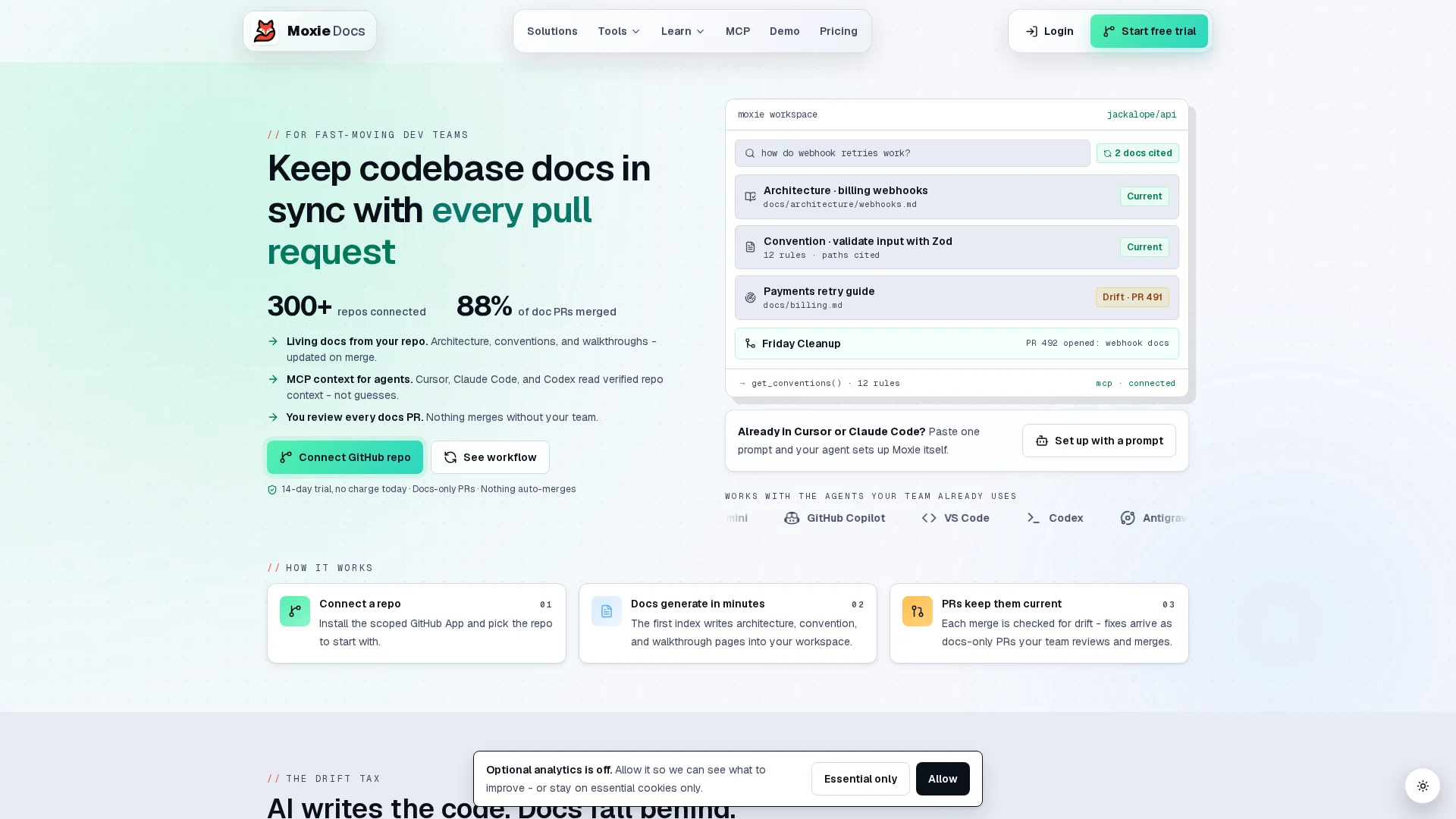
Stop chasing drift by hand. Try MoxieDocs to keep GitHub docs synced with every merge, flag gaps early, and give AI agents real code context.
Frequently Asked Questions#
Q1: How can automated tools detect content and documentation drift in 2026?#
They compare docs with code, configs, API schemas, tests, and runtime signals. Strong setups mix rule checks with semantic checks, then flag changes in CI before bad docs ship.
Q2: What are the latest methods for continuous documentation drift monitoring in AI systems?#
Teams now watch prompts, retrieval sources, model configs, and eval results. The best workflow runs on every merge and on a schedule, so silent drift gets caught too.
Q3: How does documentation drift impact AI accuracy and user trust in 2026?#
Wrong docs feed wrong context to people and agents. That causes bad outputs, wasted debugging time, and weak trust. Tools like MoxieDocs help by keeping repo knowledge current as code changes.
Conclusion#
Documentation drift is best caught in layers. Use deterministic checks first, then semantic review, then CI monitoring. Tools like Docverity and Staleguard reflect that split well. The win is simple: fewer false alarms, faster reviews, and docs your team can trust.
Republish or cite this article
You're welcome to republish this piece in full or in part. We just ask that you credit the original with a link back. See our republishing guidelines.
Attribution snippet
<p>This article was originally published on <a href="https://moxiedocs.com/blog/how-to-detect-documentation-drift-with-automated-tools-in-2026">Moxie Docs</a>.</p>Cite this article
The Moxie Docs team. "How to Detect Documentation Drift with Automated Tools in 2026." Moxie Docs, July 24, 2026, https://moxiedocs.com/blog/how-to-detect-documentation-drift-with-automated-tools-in-2026.
Read next
Moxie Docs Review: AI-Powered Documentation for Modern Dev Teams
Discover how Moxie Docs leverages AI-powered technology to streamline documentation for modern software teams, boosting efficiency for developers and technical writers.
Auto Documentation vs Living Documentation: Which Is More Effective?
Discover the differences between Auto Documentation and Living Documentation to determine which method best enhances your development workflow and maintenance.