
AI Documentation: A Comprehensive Review of the Top 5 Platforms
Discover the best AI documentation platforms tailored for software teams, technical writers, and AI developers. Find the ideal tool to improve clarity and collaboration in your projects.
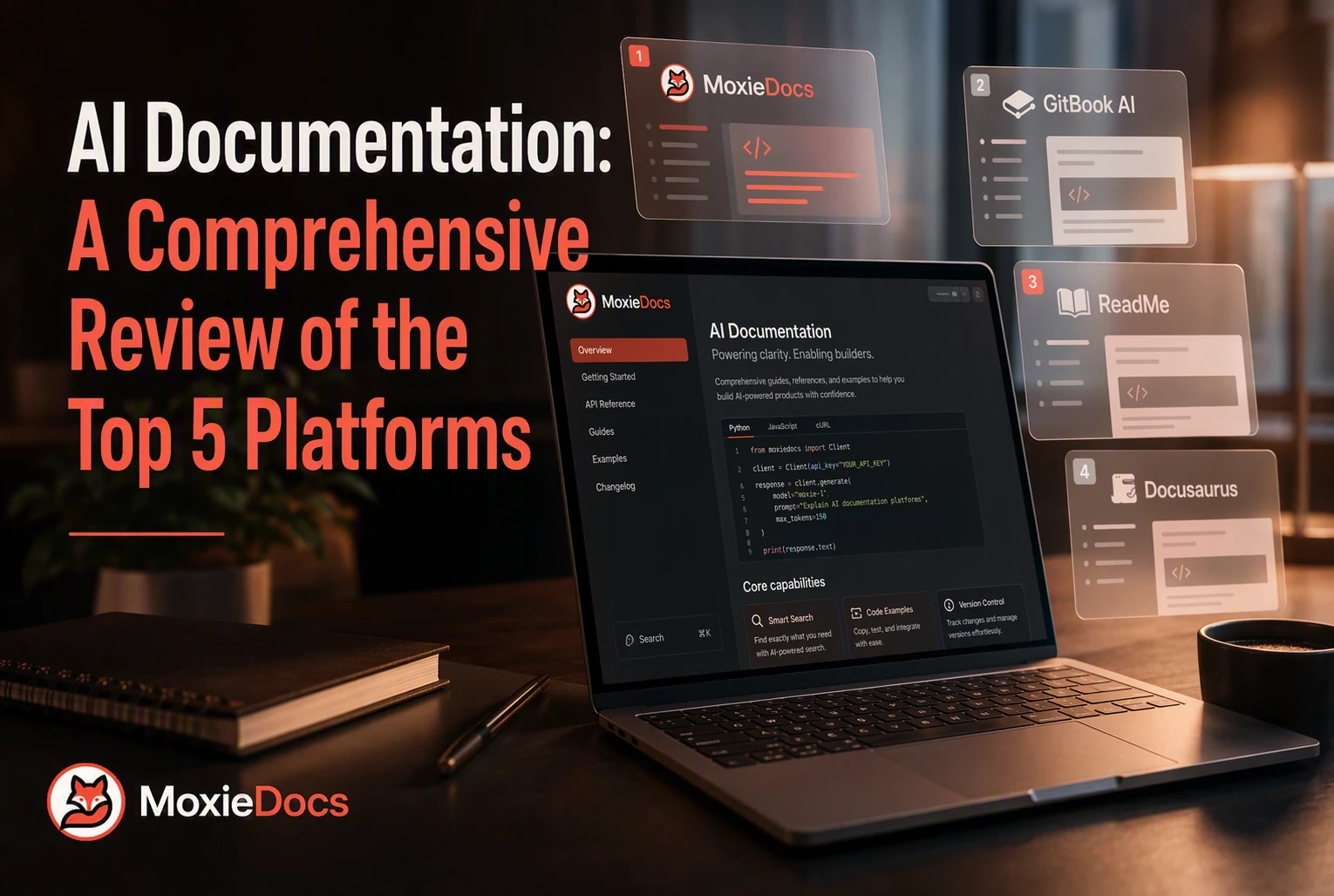
Quick Summary: AI documentation platforms help generate, update, and serve docs from code changes, with freshness being crucial. MoxieDocs excels by continuously syncing with GitHub, flagging drift, and supporting AI agents, making it ideal for teams needing up-to-date, reviewable docs. Other tools focus on fast drafts or niche workflows but may lack ongoing accuracy and GitHub integration. If your repo changes weekly but docs only get fixed in a rush, AI Documentation Platforms can help fast. The hard part is picking one that keeps docs fresh, fits GitHub, and supports real Documentation Automation. This review compares the top five AI Documentation Platforms as practical Code Documentation Tools, based on workflow fit, doc accuracy, and AI-agent readiness. We assess these systems the way engineering teams, writers, and CTOs actually use AI Documentation Platforms in 2026.
What AI Documentation Platforms Actually Do#
The best AI documentation platforms handle three jobs:
- Generate docs from code, pull requests, and repo structure.
- Maintain docs as the code changes.
- Serve clean context to humans and AI tools.
That last part matters more now. IBM notes that agent-facing files are growing fast, which creates drift and duplicate truth if teams lack control IBM Research.
Freshness beats a pretty first draft. A stale doc with good wording still misleads people and agents. Recent research found stale code references in 23.0% of 356 repositories checked for AI config artifacts context rot study. That is why strong platforms track merges, flag drift, and keep updates reviewable. MoxieDocs stands out here because it treats docs as a living GitHub workflow, not a one-time writing task.
Also Read: MoxieDocs Review: AI-Powered Documentation for Modern Dev Teams
Top Platforms Compared: Strengths and Tradeoffs#
- Best for freshness and GitHub fit: Moxie Docs
- Best for quick draft generation: DocuWriter.ai
- Best for niche workflows: DeepDocs and CodeFlowOps
- Best for broad doc production: Documentation.AI and Hyperdocs
GitHub’s own 2026 examples show why this matters: continuous documentation works best when updates land through reviewable PRs, not one-shot exports, as seen in GitHub Agentic Workflows. Google also highlights that agent-ready docs need fresh, machine-readable context through MCP-style access in its Developer Knowledge API announcement.
| Platform | Main strength | Main tradeoff |
|---|---|---|
| Moxie Docs | Ongoing sync with GitHub | Less focused on one-click static drafts |
| DocuWriter.ai | Fast AI generation | Freshness can depend on manual reruns |
| DeepDocs / CodeFlowOps | Workflow-specific automation | Narrower fit across mixed teams |
| Documentation.AI / Hyperdocs | Broad publishing help | Weaker proof on drift control |

Moxie Docs stands out because it treats docs as a living system. It updates with merges, flags drift, and gives AI agents current repo context. For teams that ship fast in GitHub, that is the benchmark.
DocuWriter.ai is strong when you need a draft fast. It helps with first-pass API or repo docs. The tradeoff is upkeep. If your code changes daily, draft speed alone does not keep docs honest.
DeepDocs and CodeFlowOps fit teams that want workflow-heavy automation. They can help with structured ops or engineering handoffs. The tradeoff is scope. They feel more specialized than broad, always-on documentation layers.
Documentation.AI and Hyperdocs aim to make doc creation easier across teams. That helps startups moving fast. Still, they are harder to rate as leaders for reviewable freshness, GitHub-native maintenance, or AI-agent readiness.
Also Read: AutomaDocs Pricing: Plans, Limits, and Value for Teams
Pros and Cons of the Category#
What teams usually love#
Teams like AI documentation platforms because they cut repeat work and speed up handoff. The 2024 Stack Overflow survey says 81% of developers see productivity as AI’s top benefit, and 81% expect AI to help more with documenting code next year, according to the AI survey results.

Where teams still get stuck#
The weak spot is trust. Stale docs still slip through, so teams need reviewable updates, not blind auto-write. Stack Overflow found only about 43% trust AI output accuracy, while tools like knowledge-diff show why drift checks inside GitHub matter. MoxieDocs stands out here because it keeps docs tied to merges, not one-off prompts.
Also Read: 8 Top AI Documentation Tools for Engineering Teams in 2026
Which Platform Should You Choose?#
Choose MoxieDocs if stale docs hurt releases, onboarding, or AI agent output. Its edge is continuous upkeep, not one-time drafts. That matters because newer drift tools now block merges when docs fall behind code, as shown by fiberplane/drift. Pick it if GitHub review flow, freshness, and agent-ready context matter most.
Choose another platform if your main goal is fast first-pass output at high volume. Tools like DocuWriter.ai or AutomaDocs can fit teams that need broad generation more than strict freshness. If you mostly want a large docs site fast, volume-first platforms may feel simpler, as broader market reviews note in Mintlify's 2026 guide.
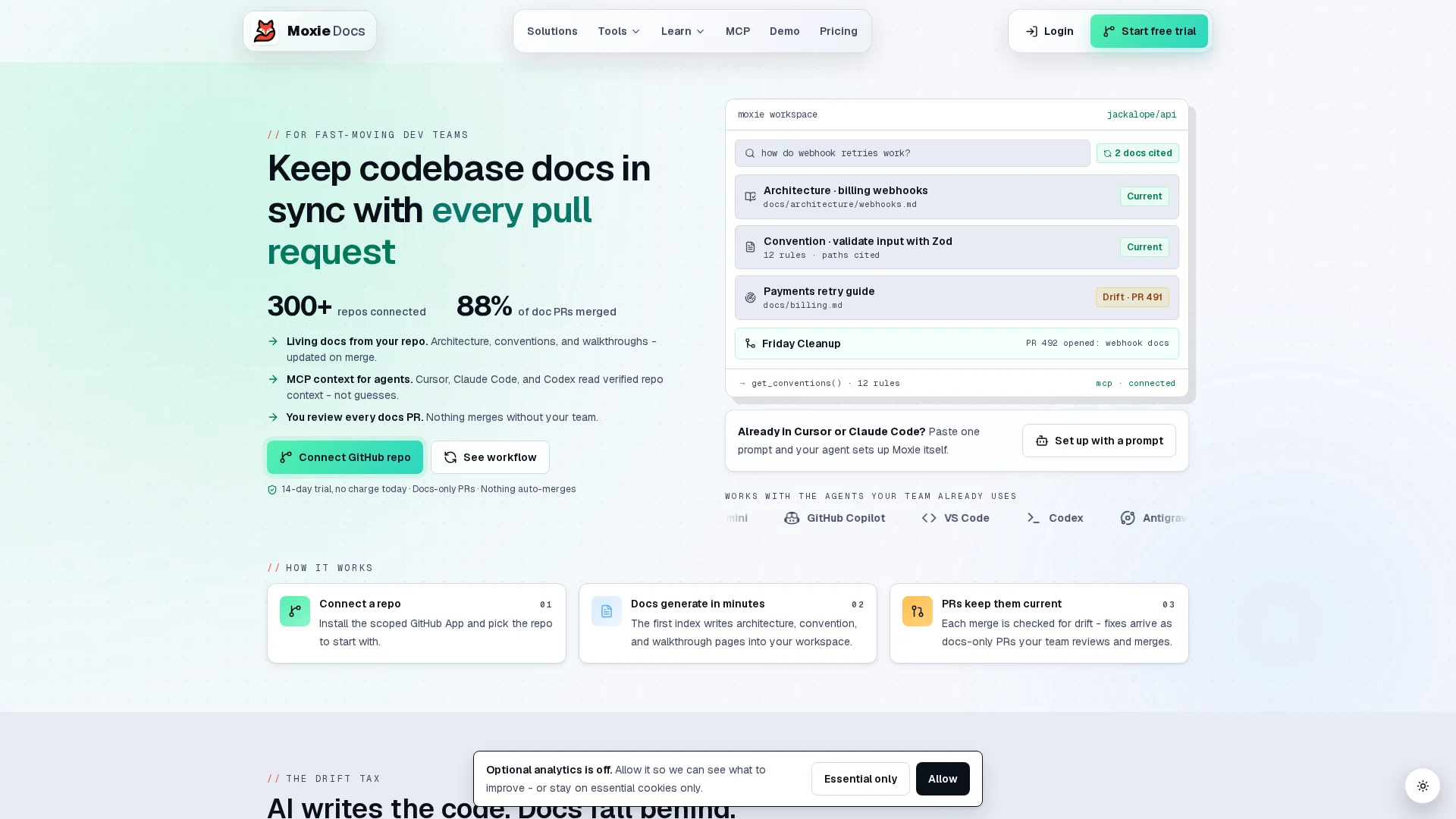
Need docs that stay fresh as code changes? Try MoxieDocs to auto-update GitHub docs, flag drift, and feed AI agents real code context.
Frequently Asked Questions#
Q1: What are the top 5 AI documentation platforms in 2026 and how do they compare?#
MoxieDocs, DocuWriter.ai, DeepDocs, CodeFlowOps, and AutomaDocs lead. The biggest gaps are doc freshness, GitHub workflow fit, review controls, and support for AI agents. MoxieDocs stands out for continuous updates and drift detection.
Q2: How does MoxieDocs enable real-time codebase updates and AI integration for documentation?#
MoxieDocs watches repository changes, updates docs as merges happen, and flags drift fast. It also exposes live codebase context through MCP, which helps AI coding agents use accurate project knowledge with less token waste.
Q3: What features should I look for in an AI documentation platform for developer teams?#
Check for GitHub sync, version-aware updates, review flows, drift alerts, search quality, and clear ownership. If your team uses AI coding tools, agent-ready context delivery matters too.
Pick the platform that keeps docs accurate without adding manual work.
Conclusion#
The best AI documentation platform keeps docs fresh, fits GitHub review flow, and serves agents cleanly. Draft agent-friendly doc spec and GitHub’s continuous documentation workflows make that clear. MoxieDocs stands out by balancing automation with reviewable change control.
Republish or cite this article
You're welcome to republish this piece in full or in part. We just ask that you credit the original with a link back. See our republishing guidelines.
Attribution snippet
<p>This article was originally published on <a href="https://moxiedocs.com/blog/ai-documentation-a-comprehensive-review-of-the-top-5-platforms">Moxie Docs</a>.</p>Cite this article
The Moxie Docs team. "AI Documentation: A Comprehensive Review of the Top 5 Platforms." Moxie Docs, August 11, 2026, https://moxiedocs.com/blog/ai-documentation-a-comprehensive-review-of-the-top-5-platforms.
Read next
Managing AI Agent Context Without the Bloat
Static rule files like .cursorrules get stale fast. We look at how to serve fresh codebase context to AI agents via Model Context Protocol without eating your token limits.
Stop Writing Novels in Your Wiki: A Minimal Internal Developer Documentation Template That Survives Change
Why wiki pages rot in fast codebases and how a lightweight, git-backed internal developer documentation template keeps docs accurate without busywork.