
Developer Onboarding Documentation Review: Is MoxieDocs Worth It?
Struggling with slow developer onboarding? We tested MoxieDocs and found out if it cuts ramp-up time by 30%—plus its hidden perks for GitHub maintainers.

Quick Summary: MoxieDocs turns GitHub repos into searchable, up-to-date onboarding docs by flagging outdated sections during merges and proposing small, reviewable updates-cutting the 28.9% of projects with stale references. It excels for fast-moving teams where AI agents need live repo context via MCP, but still requires human oversight for critical docs. Pricing depends on saved review time, not just seats, and it’s best skipped for small, stable repos with solid manual docs. The real win is reducing new hires’ lost hours chasing broken setup guides.
A new engineer can read a clean README yet lose hours mapping services, rules, deploy steps, and hidden assumptions. MoxieDocs turns a GitHub repository into searchable context, flags drift, and supports MCP coding agents. This review tests whether it solves real developer onboarding documentation gaps. We assess it against common developer onboarding tools, GitHub documentation tools, and living documentation software needs.
How MoxieDocs Supports Developer Onboarding#
From Repository Access to First Useful Change#
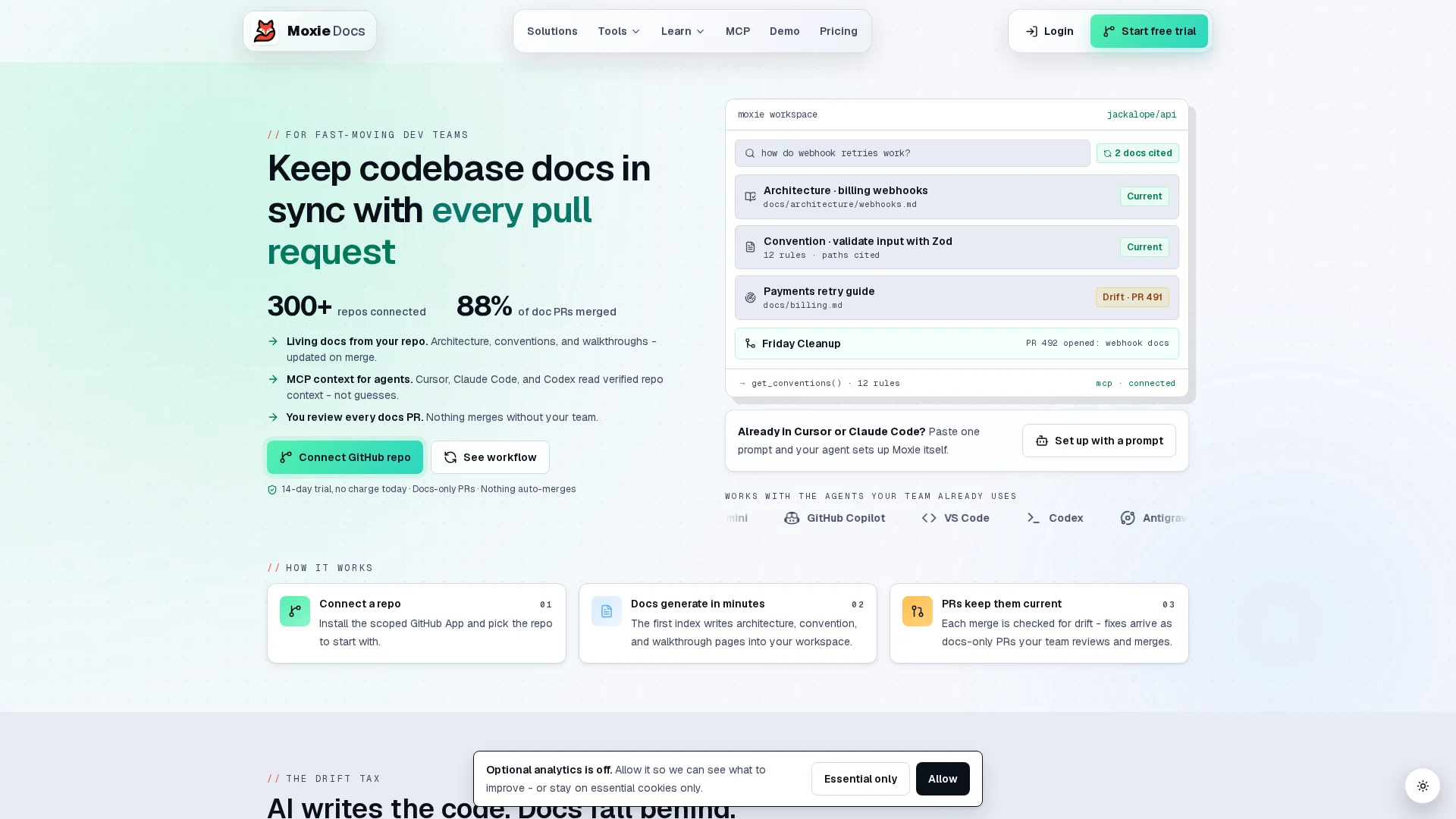
New hires need a clear map before they edit code. MoxieDocs turns a connected GitHub repository into searchable developer onboarding documentation that covers structure, conventions, and known doc gaps.
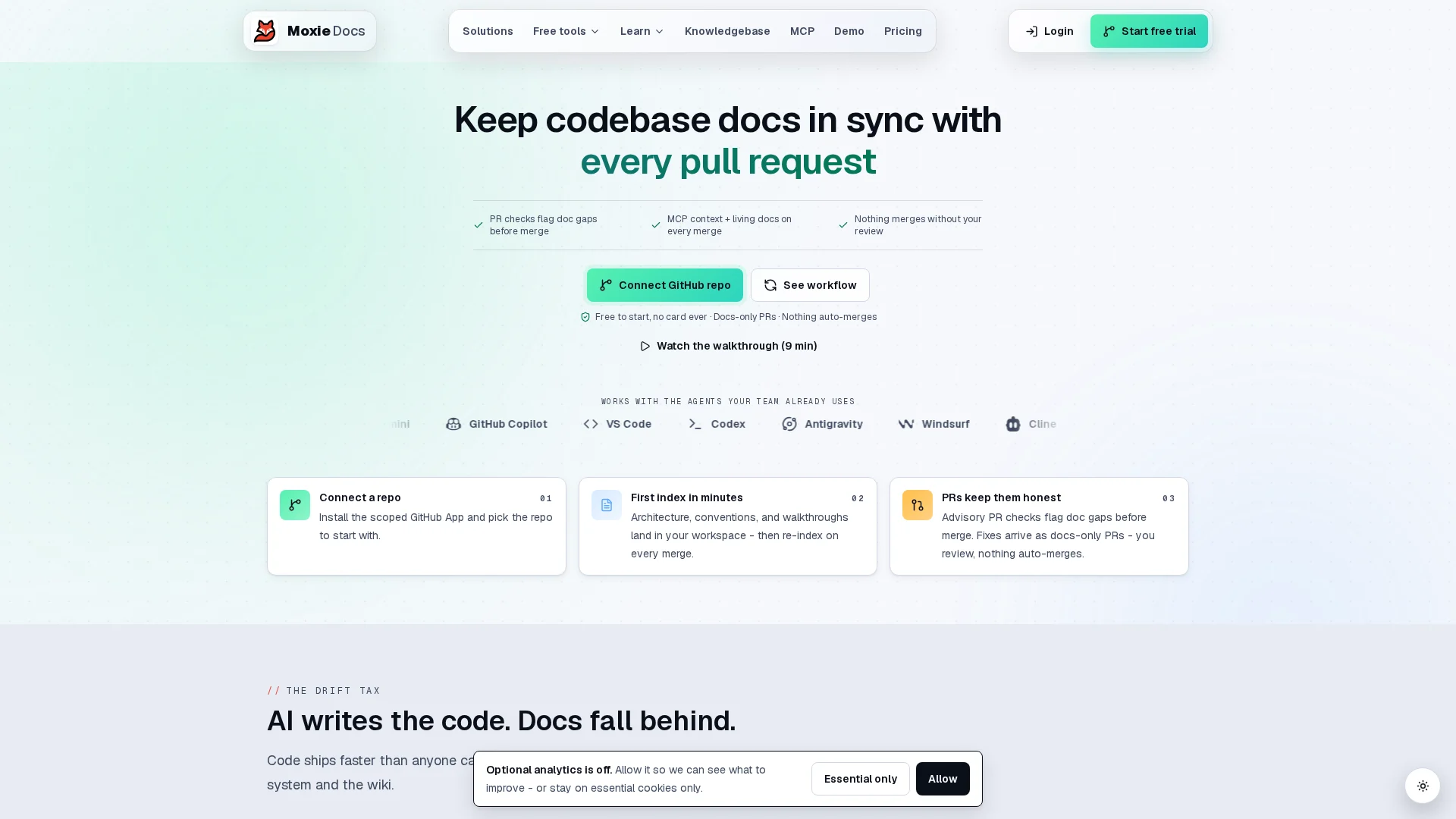
Its GitHub workflow re-checks docs on each merge and flags drift, so a new engineer is less likely to follow an old setup guide.
- Find key services and project rules quickly.
- Check verified commands before running them.
- Send live repository context to AI coding agents through MCP.
Tip: Use developer onboarding tools to guide the first small pull request, not replace code review or teammate support.
The practical win is trust. MoxieDocs keeps developer onboarding documentation close to code changes, while reviewers keep final control through reviewable pull requests.
Also Read: Living Documentation Best Practices for Agile Teams
Does It Reduce Documentation Drift in Fast-Moving Codebases?#
Drift Detection Versus Automatic Rewriting#
MoxieDocs should reduce drift if it flags docs touched by each merge, then ties proposed updates to the code change. That is more useful than rewriting whole pages on a schedule.
Research found outdated references in 28.9% of popular GitHub projects, so drift is not a small edge case. A large repository study supports using merge-time checks.
For developer onboarding tools, the key test is trust:
- Flag the exact doc section and changed files.
- Draft a small update, not a fresh rewrite.
- Keep a human approval step for architecture and runbooks.
Tip: Treat auto-generated text as a pull request. Reviewers need evidence, not polished guesses.
Automatic rewriting can save time, but it may change correct context or hide a bad inference. MoxieDocs is most credible when it detects drift first and makes reviewable, narrow edits.
Also Read: MoxieDocs Review: AI-Powered Documentation for Modern Dev Teams
MCP Context, GitHub Fit, Pricing, and Governance#
Where MoxieDocs Fits Among Alternatives#
MoxieDocs fits teams that need GitHub docs to stay tied to each merge, while giving AI agents current repo context through MCP. MCP is an open standard for sharing data, prompts, and tools with LLM apps, as the official specification explains.
| Need | Best fit |
|---|---|
| One-time code docs | DocuWriter.ai |
| Broad code explanation | DeepDocs |
| Living GitHub context and drift flags | MoxieDocs |

Pricing should be confirmed in a sales call. Judge it against saved review time, not seats alone.
Ask for GitHub permission scope, data retention, audit logs, and a clear path to revoke access.
For governance, limit access to selected repos, review generated updates in pull requests, and assign a human owner for key onboarding pages.
Also Read: 8 Top AI Documentation Tools for Engineering Teams in 2026
Pros and Cons, and Is MoxieDocs Worth It?#
MoxieDocs is worth testing if stale docs slow onboarding or confuse AI coding agents. Its GitHub workflow indexes repos, flags drift, and proposes updates for review.
- Pros: Living docs, MCP context, and reviewable PRs keep knowledge close to code.
- Cons: It is GitHub-focused, needs trust in a hosted service, and still needs human doc review.

Best fit: Teams with frequent merges and new engineers. Skip it for stable, tiny repos with strong hand-written docs.
| Decision | Verdict |
|---|---|
| Fast-moving GitHub team | Worth it |
| Minimal change volume | Trial first |
Give new engineers trusted repo context from day one. Try MoxieDocs to keep onboarding docs aligned with every merge.
Frequently Asked Questions#
Q1: how to onboard a new engineer quickly#
Give them a clear repo map, setup steps, key owners, and a small first task. Living docs help them trust the context without asking for outdated links.
Q2: How does MoxieDocs reduce documentation drift in fast-moving codebases?#
MoxieDocs ties documentation updates to GitHub merges. It flags stale content and refreshes context as code changes, so onboarding guides are less likely to describe removed files or old flows.
Q3: Can MoxieDocs replace manual developer onboarding docs entirely?#
No. Teams still need human guidance for culture, priorities, access rules, and first-week goals. MoxieDocs is strongest for codebase facts that change often.
Q4: What’s the ROI of auto-generated docs like MoxieDocs for engineering teams?#
Measure fewer repeat questions, faster first pull requests, and less time spent fixing stale pages. ROI grows when frequent merges make manual documentation upkeep costly.
Conclusion#
MoxieDocs is worth testing if it keeps repository context current and reviewable. Strong onboarding docs need clear structure, concise guidance, and reliable ownership, as GitHub recommends.
Republish or cite this article
You're welcome to republish this piece in full or in part. We just ask that you credit the original with a link back. See our republishing guidelines.
Attribution snippet
<p>This article was originally published on <a href="https://moxiedocs.com/blog/developer-onboarding-documentation-review-is-moxiedocs-worth-it">Moxie Docs</a>.</p>Cite this article
The Moxie Docs team. "Developer Onboarding Documentation Review: Is MoxieDocs Worth It?." Moxie Docs, August 23, 2026, https://moxiedocs.com/blog/developer-onboarding-documentation-review-is-moxiedocs-worth-it.
Read next
MCP Security Risks Explained: Tool Poisoning, Confused Deputies, and the Lethal Trifecta
MCP servers introduce a new attack surface: tool poisoning, rug pulls, confused deputy, and the lethal trifecta. What is real, and how to mitigate it.
7 AI Code Conventions That Keep Models and Teams Aligned
Discover essential AI code conventions that ensure models and development teams stay aligned, improving efficiency and consistency across AI projects. Practical strategies for engineering leaders and teams adopting AI.